Through a series of links, I wound up at a blog advocating mechanically (or electronically, I presume) limiting the maximum speed of passenger vehicles to 55 kilometers/hour (34 m.p.h.). Scott (the blog's publisher) lists the benefits, among others as: elimination of oil imports; reduction of CO2 emissions to below 1970's levels;
reduced loss of life and reduced injuries in motor vehicle accidents; reduced air pollution from exhaust; reduced particulates from tire wear; reduced energy in automobile manufacturing due to smaller and lighter components; reduced expenditure for infrastructure maintenance; increased motivation to use (now comparatively much faster) public transportation; and others.
He addresses many of the objections he anticipates as well, though I doubt that many who contemplate his suggestion will agree that he has adequately done so. He moderates his comments and states that a huge portion of the comments he's received consist only of name calling and doesn't publish them. In fact, there are very few comments published. I left several; time will tell if he publishes them.
And though a few of the comments I posted related to his erroneous use of "exponentially" and his stating that aerodynamic drag (as opposed to power required to overcome it) varies with the cube of speed (rather than the square), my main point of contention was that he makes broad claims (elimination of oil imports, reduction of CO2 emissions to pre-1970's levels) with no data or calculations to support them. This is something I try never to do, as claims without backup are plentiful on the 'tubes. I'm willing to be convinced, but he'll have to convince me.
Further, I am instinctively opposed to mandates and top down controls, so I suggested that the externalities of fast driving be paid for by those doing the driving, probably by a tax. With OBD-II on all modern cars, this could easily be accomplished at registration renewal time without big brother-like GPS tracking. The idea would be that people would be taxed on the extent to which they exceeded, on average, some speed and probably multiplied by the number of miles driven. I can already hear the howling!
But let me do his job and suppose such a thing was done. Would we eliminate oil imports? This needs to be a two part question because we'd use less energy to travel and use less energy to manufacture automobiles. For the first part, I'm going to assume that the adjustment has been made and that enough of the new variety of cars optimized for such a maximum speed are on the road to use them as the de facto standard. In the real world, that will take a while but let's see where it leads us.
We used (in 2005) 320,500,000 gallons of gasoline per day at 17.2 m.p.g. I made liberal (but not completely unrealistic) assumptions on vehicle characteristics of weight, drag coefficient, rolling resistance, and area and calculated in the usual way - details can be provided if requested- and determined that we'd be able to get vehicles achieving about 134 m.p.g. after this rule is implemented and the situation stabilizes as described. At that rate, we'd save about 87.2% of the gasoline we now use, or 279,000,000 gallons per day. Now, we get about 19.5 gallons out of a barrel of oil, so we'd save about 14.3 million barrels per day. This is, in fact, more than we import so Scott is correct. This doesn't even include savings from reduced energy use in manufacturing lighter vehicles. I'll attack that, and CO2, in a subsequent post.
Who's in?
Sunday, February 21, 2010


Saturday, February 20, 2010
The Nissan Leaf

Let's look at the combined aerodynamic and rolling resistance efficiency of the vehicle. The Leaf is claimed to deliver about 100 miles on a full charge, the lithium ion battery pack capacity is stated to be 24 kilowatt-hours or about 86.4 megajoules. The electric motor is less than 100% efficient in its use of the energy in its source. Based on this page and the 80 kilowatt (or 107 horsepower) motor in the Leaf I'll use 92% (the table shows the minimum as 91.7%). Also, the Leaf site discusses "0% to 100% charge" so I'm going to assume that the vehicle uses all 24 kilowatt-hours of energy in the battery pack to go 100 miles. Thus, the Leaf uses .92*24=22.1 kilowatt hours or 79.6 megajoules to go 100 miles.
How does this compare to "miles per gallon?" The 79.6 megajoules is the energy in about .66 gallons of gasoline, but the internal combustion engine is quite inefficient so I'll use 22%. Then we'd be considering a car that goes 100 miles on (0.66/0.22) or about 3 gallons. Thus, we're looking at a car whose efficiency in terms of aerodynamics and rolling resistance is about that of a gasoline burning car getting 33 m.p.g. Seems quite reasonable, though certainly not awe inspiring.
How about cost? I drive about 62 miles per day year around, so I'd use about 62/100 of a full charge, or about 14.9 kilowatt-hours from the battery pack. Let's assume the charging system is 85% efficient, so I need (14.9/.85) or 17.5 kilowatt-hours of electricity. This would probably be at a marginal rate of $0.17/kilowatt-hour since I'd invariably be over my baseline rate with the City of Anaheim. So I'd spend 17.5*0.17 or $3.01 per day on energy to drive. This is, of course, $3.01/62 or $0.049/mile. Right now in my Land Rover LR3 HSE I'm spending about $0.14/mile on gasoline. The Leaf would provide considerable savings, amounting, in the course of a year, to about $2,060. Certainly, that's nothing at which to sneeze (grammatical pedant that I am).
As to performance, the Leaf boasts a torque (from a dead stop) of 280 Newton-meters (208 pound-feet) and a top speed of over 140 km/h (87 mph). It will accept a full charge from a compatible 220 volt system in about 8 hours, about twice that from a 110 volt circuit. At a suitable quick charge station, it will take an 80% charge in under half an hour and a boost good for about 35 miles in about 10 minutes. Such suitable stations are, at the moment, mostly a distant dream however.

Addendum: How much might I reduce my costs if I built a solar charging system to charge the vehicle's battery pack during my working hours? I went here to find the insolation available, using average insolation, the month of March, and a horizontal flat plate to see this map:

Conservatively, 4.5 kilowatt-hours/meter^2/day are available on average. If I'm fortunate, maybe I can create a collector of 2 meter^2. If I'm even more fortunate and technology smiles, perhaps I can find cells with 18% efficiency and provide circuitry to charge the vehicle. Thus, I'd get 2*4.5 kilowatt-hours*0.18 or about 1.6 kilowatt-hours. This would be enough to bring the vehicle from, say, 65% charged to 71.7% or to go a little less than an extra seven miles. To bring it from fully discharged to fully charged would take a little under 15 days. I can do perhaps a little under twice as well in June but still, seemingly not worth the trouble and expense.
Tuesday, February 09, 2010
More reasons to be embarrassed to be called conservative
So what am I to make of the descriptor "conservative" being used to characterize people who hold opinions such as those expressed by the participants in this clip? Here we see, as we saw with Bush, a celebration of intellectual laziness in the guise of condemning the "elite." We wouldn't think of such condemnation of elite athletes, but by God let no one more learned than Homer Simpson dare to govern us.
When one is expected to apologize for holding informed opinion based on study and inquiry and to celebrate a so-called "leader" who can't remember the list "energy,

Friday, February 05, 2010
The Onion vs. The Science Channel
I've mentioned on several occasions my level of disappointment with the Discovery Network's lineup of channels and shows and the extent to which they have debased the original concept of bringing some level of scientific authenticity to the wasteland that is television. But a big hat tip to Michael at Only In It For The Gold for pointing me to the far superior Onion treatment.
Udate: So I'm watching "G Word " ("G" is for green, I suppose) on Planet Green (a Discovery Channel) and the host, Summer Rayne (think Johnny Rivers - "taps at my window"), is in Abilene, TX interviewing someone from AES Energy Systems at their Buffalo Gap wind energy facility. It's not really bad until Ned Hall, their President, says "this machine is 1.5 megawatts." Summer asks "and what does that mean?" Hall says "it's enough electricity for your home for the whole year." Ummm, an analogous inanity would be me saying "my car goes 125 miles per hour. That's enough to go from here to San Francisco." And this, let me repeat, is the President of an energy company.
Udate: So I'm watching "G Word " ("G" is for green, I suppose) on Planet Green (a Discovery Channel) and the host, Summer Rayne (think Johnny Rivers - "taps at my window"), is in Abilene, TX interviewing someone from AES Energy Systems at their Buffalo Gap wind energy facility. It's not really bad until Ned Hall, their President, says "this machine is 1.5 megawatts." Summer asks "and what does that mean?" Hall says "it's enough electricity for your home for the whole year." Ummm, an analogous inanity would be me saying "my car goes 125 miles per hour. That's enough to go from here to San Francisco." And this, let me repeat, is the President of an energy company.
Saturday, January 16, 2010
Climate "reparations"
In my post on my family's carbon footprint I concluded that we are major offenders. My friend Michael Tobis of the blog "Only In It For The Gold" provided a link to an interview by Amy Goodman of the Democracy Now web site, television, and radio program. The interview was with Naomi Klein, an author and journalist with a decidedly anti-capitalist, anti-corporate, some would say anti-western point of view (though I snarkily note that her books are for sale at the usual outlets).
The interview centered on the contention that the (primarily western) countries most responsible for the carbon dioxide (and other greenhouse gas) emissions should be responsible for both the most drastic reductions in emission rates (i.e., primarily in the reduction in the burning of fossil fuels) and for providing the capital to developing countries likely to be most affected by climate change for mitigation of the effects of climate change and for steering their economies toward a trajectory of sustainable development. This latter is considered to be much more expensive than the non-sustainable model exemplified by western economies.
This certainly seems to be a reasonable position at the outset - we in the U.S. emit at about five times the worldwide average per capita and, until recently, were the largest emitter as a nation. China has now surpassed us as a nation, and this will be of note later in this post. Klein characterizes this position as "you broke it, you bought it."
We've certainly benefited from our emissions, achieving a standard of living to which many citizens of the countries demanding "reparations" aspire and doing so by converting fossil fuel to carbon dioxide and water at prodigious rates. So is it really as simple as "you Americans have emitted the carbon dioxide that will drive climate change. You must pay for the mitigation and you must pay us to develop in a way different than the one you chose."
Let's look at China and the U.S. The Union of Concerned Scientists web site shows that, in 2006 the U.S. emitted 5902.75 million metric tons of carbon dioxide, while China emitted 6017.69 million metric tons. For the U.S., this is 19.78 metric tons per capita, while for China it's 4.58 metric tons. That makes us four times as bad, right?
Sorry, I don't totally accept that. If we're "bad" for our per capita emissions, then why is China not equally "bad" for its population? The fact is, the Earth doesn't care whether a ton of carbon dioxide was emitted by one person or by five. China's land area is almost identical to that of the U.S., so it's not as if their percentage of the land area of the Earth somehow justifies their enormous population. And as China's wealth increases so will its emissions, despite China's pledge to reduce its so-called "carbon intensity."
What, then, for countries such as Bangladesh? Here's a country that is inundated regularly by flooding and is desperately poor. And yet it's the seventh most populous country in the world and has a population density 35 times that of the United States. That density has increased by about 2 1/2 times since 1970. When looked at in terms of CO2 emissions per capita, the U.S. is about 709 times as intensive as Bangladesh. When looked at by CO2 emissions per U.S. dollar of purchasing power parity adjusted GDP, the U.S. is about twice as intensive (this reflects the extremely low GDP of Bangladesh). Finally, when looked at in terms of CO2 per unit of land area, the U.S. is about 2.2 times as intensive, reflecting the large population of Bangladesh compared to the relatively small land area. Interestingly, Bangladesh has a higher economic output per unit of land area than the U.S.
While one can endlessly play games with countries' numerical data, I want to make the point that the contention that it's as easy as requiring the "rich" countries to pay for all consequences of atmospheric CO2 and for the sustainable development of the developing (poorer) nations is naive. This would, in many cases, merely be rewarding overpopulation. Overpopulation is the 700 pound gorilla in the room and, no matter what else we do or stop doing, if we don't control population it's all for naught.
No one should think, based on this, that I believe that we as a country, or that I individually can wash our/my hands of responsibility. We certainly have a huge role to play in emissions reduction, mitigation, sustainable development, and humanitarian aid to countries who "missed the boat" on the easy and carefree exploitation of fossil fuels. But totaling each country's cumulative emissions, dividing into world cumulative emissions to derive the fraction of "responsibility" for reduction, mitigation, and sustainable development investment is not something that I believe is right or that I could support.
Monday, January 04, 2010
Mundane examples of energy
I was walking up the hill to my house and started to think about energy. I thought I'd give a few examples. For starters, my "resting metabolism" is somewhere around 1900 kilocalories per day. This is energy per unit of time, or power. Using Google's terrific calculator, this converts to a more familiar figure for power, 92 watts. So it takes about the same amount of energy to run me for an hour as to light a small room for an hour.
OK, now how about the hill? Using Google Earth I find that I gained 91.1 meters in elevation on the climb. Using the National Geodetic Society's Surface Gravity Predictor I find my local gravitational acceleration to be 9.795 meters/second^2, or as Rhett over at Dot Physics prefers, 9.795 Newtons/kilogram. I know this rounds to 9.80 but it's kind of cool to find and use the more precise number. My mass is an embarrassing 84.82 kilograms, so raising it up that hill requires converting 84.82*9.795*91.1 (mass*gravitational acceleration*height) or 75,690 joules of food energy to do the work to accomplish. This is 18 kilocalories (the type referred to in nutritional discussions as "calories")or a tiny bit over four plain chocolate M&M's. I don't use the energy in the M&M's with 100% efficiency though. In this post I estimated an efficiency of 11% to 14% so I'll figure that I'd need to eat about eight times as much fuel energy or 32 plain chocolate M&M's.
Of course more is burned since I'm lifting my feet up and down, swinging my arms, etc. To estimate this, I'll add a "walking briskly" amount to the climb energy. The linked site says I'll burn about 460 kilocalories/hour in my "brisk walk." I run down the hill and walk up, so I'm going to speculate that the running aspect makes up for the energy gain of going down hill. I do try to keep my heart rate in the so-called training zone so this shouldn't be too far off. This run/walk takes me about 42 minutes, and so should burn about (42/60)*460 or 322 kilocalories. Adding the 18, my exercise burned about 340 kilocalories or 1,420,000 joules. This is also about 395 watt hours, so this amount of energy will light a room (with a 100 watt bulb) for about four hours. It's also the amount of heat energy released by the gasoline in about one and a half shot glasses. My Land Rover LR3 HSE would possess this amount of kinetic energy (not counting the energy of the rotating masses) when traveling at about 73 m.p.h.
Tuesday, December 29, 2009
But seriously folks...
I was watching "Planet Mechanics" (a mildly interesting show that won't save the world but makes more sense than the silly "Discovery Project Earth" series). While reading Dr. Michael Tobis' latest post in his blog "Only In It For The Gold" during a commercial break, I heard, out of the corner of my ear, a commercial for Dr. Frank's Joint and Muscle Pain Relief." The anecdotal claims being made were impressive, so I listened a little more closely and heard the word "homeopathic." Quoting a famous line from the history of my beloved White Sox, "say it ain't so Joe!"
One of my constant sorrows is the susceptibility of the American public (the only public with which I'm familiar) to the most ludicrous pseudoscientific claptrap. But to see such a product advertised on a network representing itself as educational was shocking.
Delving into the website, I perused the producer's explanation of homeopathic cures and of so-called "homeopathic provings" which they take care to explain are "entirely different than the scientific double blind study methods most people are familiar with." I just bet they are. Allow me to quote further from the site: "Homeopathic "provings" are, in essence, the proof that homeopathic scientists and doctors use to demonstrate to themselves that specific homeopathic ingredients work for specific symptoms" (emphasis mine). Nope, I'm not kidding.
The idea, as I understand it, is that you expose healthy subjects to random substances and see what symptoms are caused. Then you take the substance, dilute and agitate the substance in a specialprocedure ritual called "succussing" to concentrations as low as one trillionth the original (or even lower). This is then used to cure the symptom caused by the substance in its original concentration. You just can't make this stuff up (though Samuel Hahnemann could).
Of course, the practitioners of this lunacy are immersed in conspiracy theories revolving around the iron grip of "big pharma" and "allopaths" (i.e., real doctors) controlling the media, the research institutions, etc. I haven't the patience to debunk this hooey, though such sites as Quackwatch do an excellent job of it. But it pains me to see people encouraged to send money to such charlatans on an educational channel.
Update: In my noodling around to find information on this bunkum, I happened upon this site. I may have to change my template.
Update 2: Looking at their "Our Formula" page, I note that they claim 10 "homeopathic ingredients." Though there seems to be a mathematical error wherein they think 10^-6 is one ten millionth and they claim that all ingredients are diluted "one trillion times or more," it appears as if five of the ingredients are diluted to one millionth of their original concentration and five were diluted to 1 part in 10^30. Hmmm... It looks like the container holds 40ml of "substance." Considering that Avogadro's number (the number of molecules in a mole of the substance) is about 6*10^23 and a mole of water is about 18 cm^3 (or 18ml) and this is mostly water at 1 g/cm^3, there are probably somewhere on the order of 2.2 moles or 1.2*10^24 molecules in a bottle. For the ingredients being diluted to 1 part in 10^30, this means there's about a chance in 800,000 that a molecule of any such ingredient will be found in a bottle. Seriously.
One of my constant sorrows is the susceptibility of the American public (the only public with which I'm familiar) to the most ludicrous pseudoscientific claptrap. But to see such a product advertised on a network representing itself as educational was shocking.
Delving into the website, I perused the producer's explanation of homeopathic cures and of so-called "homeopathic provings" which they take care to explain are "entirely different than the scientific double blind study methods most people are familiar with." I just bet they are. Allow me to quote further from the site: "Homeopathic "provings" are, in essence, the proof that homeopathic scientists and doctors use to demonstrate to themselves that specific homeopathic ingredients work for specific symptoms" (emphasis mine). Nope, I'm not kidding.
The idea, as I understand it, is that you expose healthy subjects to random substances and see what symptoms are caused. Then you take the substance, dilute and agitate the substance in a special
Of course, the practitioners of this lunacy are immersed in conspiracy theories revolving around the iron grip of "big pharma" and "allopaths" (i.e., real doctors) controlling the media, the research institutions, etc. I haven't the patience to debunk this hooey, though such sites as Quackwatch do an excellent job of it. But it pains me to see people encouraged to send money to such charlatans on an educational channel.
Update: In my noodling around to find information on this bunkum, I happened upon this site. I may have to change my template.
Update 2: Looking at their "Our Formula" page, I note that they claim 10 "homeopathic ingredients." Though there seems to be a mathematical error wherein they think 10^-6 is one ten millionth and they claim that all ingredients are diluted "one trillion times or more," it appears as if five of the ingredients are diluted to one millionth of their original concentration and five were diluted to 1 part in 10^30. Hmmm... It looks like the container holds 40ml of "substance." Considering that Avogadro's number (the number of molecules in a mole of the substance) is about 6*10^23 and a mole of water is about 18 cm^3 (or 18ml) and this is mostly water at 1 g/cm^3, there are probably somewhere on the order of 2.2 moles or 1.2*10^24 molecules in a bottle. For the ingredients being diluted to 1 part in 10^30, this means there's about a chance in 800,000 that a molecule of any such ingredient will be found in a bottle. Seriously.
What's my house worth?
I live in Southern California, an area of the country where by almost universal agreement, housing prices are completely out of touch with reality. But what does this actually mean? What "should" a house be worth? Of course the first answer is that something is worth whatever a willing buyer will pay that a willing seller will accept. Thus, my house was "worth" what I paid for it when I bought it. But no willing buyer at that price could now be found and economists say that housing values are retreating to a "more normal" level. But what does this mean?
Let me start by saying that I'm no real estate expert, nor am I an economist. I'm merely a curious person who likes to read and analyze, particularly with numbers. Now I recall reading, many years ago, an expert's opinion that a house should ultimately be valued at the net present value of the cash flows that would be available by renting the house. I can use this as a starting point and see where it gets me.
So then, what "should" be the value of a house based on the rent assumption? As is usually the case in my blog posts, I have to make some assumptions and estimates Let's assume that a household has an income of $70,000/year and can devote 35% (as is often recommended) of the 65% left after taxes, or $15,925 per year to housing. Let's further assume that this household occupies a house of 1500 ft^2 (neither excessively small nor large). Further, let's assume that the house requires about 4% of its value in maintenance each year and 2% in taxes and insurance. I'll assume that a real rate of return (net of inflation) of 7% is the minimum requirement. Finally, I'll assume that, over the "period of interest," inflation as applicable to the home purchaser is at 4%.
All right, then what amount of money would allow the receipt of $15,925/year less the taxes, insurance and maintenance to result in a return of 11%? Simplistically, the equation is 15925-.06*x=.11*x. Solving yields a house value of $93,676.47, or $62.45/ft^2. I purchased my house for dramatically more than that so, by this criterion, I overpaid. Ah, but our household income exceeds $70,000/year so it's reasonable to assume I'll rent a nicer home with my income. Adjusting the rent by the income ratio (probably a pretty bad assumption) I can estimate that I overpaid by a factor of about 1.8.
Of course, I also purchased the property my house is on, the safety of the neighborhood in which I live, the school system my children attend, etc. It's hard to put a monetary value on these things, but I could rent them as well. This isn't making me feel good, so what about the replacement value? Well, evaluating building a home with the materials in my house, together with the landscaping, hardscaping, etc. might cost about 3/4 of what I paid for the house. Adding the land value gets me somewhat closer to the actual price paid.
So what can be concluded? Well, to start, the fact that the replacement value of my property isn't that far off of what I paid for it combined with the fact that using the rental value evaluation yields a much lower number shows that Southern California housing is out of the price range of "average" incomes even without regard to the "asset bubble" aspects of it. Duh. It also may portend a continuing secular downward trend in residential real estate values. $70,000/year is not poverty level income, even in California, so I think I'd best be prepared for lower valuations.
Saturday, December 12, 2009
"18 Kids and Counting (19 now)", "Quiverfull", seriously?
Jim Bob and Michelle Duggar and their 18 children (now 19 with their newest indefinitely in neonatal intensive care) are the central focus of the TLC reality show 18 Kids and Counting. And there's an Evangelical Christian movement called "Quiverfull" whose primary tenet is to eschew any form of birth control and "joyfully accept children as a gift of God" in accordance with God's direction to "be fruitful and multiply." And, in fact, the Duggars are conservative Baptists. That said, two things need to be made very clear before going on: the Duggars claim no association with the Quiverfull movement; and, though covert white supremacy motivations are sometimes attributed to the Quiverfull movement, it appears to be a genuine philosophy of adherence to the joyful acceptance of what members believe to be God's divine direction.
But, motivations aside, what impact do such decisions have? While it's a certainty that the human population does not now and has never grown at a well-defined exponential rate, this is quibbling. The Earth's population has, for the past 100 years or so, exhibited a doubling rate on the order of 60 years. While the actual number is by no means beyond debate, surely we can all agree that there's some maximum number beyond which the Earth's resources cannot support us in a standard of living we'd accept, whether that number is nine billion, 12 billion, or two billion.
This makes the celebration of a bodily function that any gerbil can master not merely inane but harmful. We've seen an increasing number of amoral fame seekers doing "whatever it takes" to achieve a low brow fame by getting onto reality shows (e.g., the balloon boy Heenes, Tareq and Michaele Salahi and the White House party crash, the so-called octomom) It seems clearly destructive to grant celebrity to those who engage in an obviously non-sustainable practice.
Regardless of where you may stand on anthropogenic global warming, carbon footprint is a reflection of energy and resources used and these are indubitably strictly limited, classical economics notwithstanding. And nothing a person can do contributes more to carbon footprint and hence resource utilization (that is, depletion) than having children. And having them in the United States, where we each use energy at the rate of 11 kilowatts is as destructive as it gets.
I remember when "TLC" stood for "The Learning Channel," but a look at their program guide shows that they left that concept behind years ago. I'm sure they did so because the American appetite for actual learning is minimal and more advertising dollars can be gleaned with reality television. This is sad to such as I of course, but I see no likelihood of a reversal of this trend. And I'm by no means in favor of the imposition of top down rules on content. But is it really necessary to celebrate a lifestyle that can hardly be beat for the expediting of the destruction of civilization?
Wednesday, December 09, 2009
Push lawnmower?
Tim Garrett, an associate professor of atmospheric sciences at the University of Utah, makes the provocative claim that global warming is unstoppable. It's a very interesting argument and is reminiscent of Jevon's Paradox. I'll have to do more thinking before I post on the crux of Dr. Garrett's main argument, this post is about a minor point in the article linked above.
Garrett opines that conservation and efficiency are useless in the long term with respect to minimizing humanity's primary energy conversion but yet he bicycles to work, line dries his clothes, and uses a push lawnmower. Ah, there's something into which I can sink my meager teeth. Is using a push lawnmower more Earth friendly than an electric or gasoline mower? I'm going to make a guess and then see if I can confirm or refute the guess with numerical estimates. You'll have to trust that the guess is prior to the calculation. My guess is that the electric lawnmower is most Earth friendly, followed by the push mower with the gas mower bringing up the rear.
First, I'll have to state my definition of Earth friendly. I'm going to go with primary energy consumption for all inputs, i.e., for the electric mower it will be the electrical energy used by the mower plus the energy required to generate and transmit the electricity. The gasoline will be the gas used by the lawnmower plus all energy used in extracting, refining, and distributing the gasoline. I won't include gas for the car to go to the gas station since that trip will be added to a fuel trip for the car. For the push mower, it will be the energy used by the person pushing plus the energy used in planting, fertilizing, harvesting (or slaughtering, etc.), and distributing the food providing the energy. I won't include the embedded energy in the lawnmowers, though that may hurt the push mower. Needless to say, there's ample room for error in this analysis but damn the torpedoes, full speed ahead.
Let's set the lawn as follows: 1,500 meters^2 (a little over 16,000 feet^2 or about 0.37 acres). Starting with the gas mower, I'll look at the Honda HRX217K2HMA. It has a cutting width of 21" but I'll use 20", there must be some overlap. Its maximum self-propelled speed is 4 m.p.h., I'll go with 3 as an average. Cutting 1500 meters at 20" requires 1.84 miles of mowing, at 3 m.p.h., that will take 0.613 hours. Sounds about right. The mower uses the Honda GCV190 engine, which uses 1.21 quarts/hour of gasoline. Therefore, it will use about 0.742 quarts or about 0.186 gallons to mow the lawn.
Using the estimates from my previous post, the 0.186 gallons will require a total on the order of 2.84*10^7 joules of primary energy from an oil well. To this I must add the energy required to walk 1.84 miles and using other figures from the same post, this will require 181 kilocalories or 6.4*10^6 joules of primary energy to produce. This is yields a total of 3.48*10^7 joules (Big hat tip to Chris for pointing out the factor of 100 error in my original post).
For the electric mower, I'll use a rechargeable, the Earthwise 20 in Cordless Electric Lawn Mower. I'll reduce the cutting width by an inch as for the gas mower and find that I'll travel 1.93 miles. I'll figure that I'm going a little more slowly, say 2 m.p.h., since it's not self-propelled. Thus, I'll need 0.96 hours or 58 minutes. The specification says that a charge is good for 45 minutes (give or take) so I'll need 1.29 charges. This is for a 24 volt, 17.2 ampere-hour battery that I'll assume we recharge when it's 80% discharged. Thus, a charge uses 1.19*10^6 joules and the lawn takes 1.54*10^6 joules of electricity from the wall socket. Again using figures from my earlier post linked above and assuming some fossil fuel (coal, natural gas) is used, this quantity of energy will require about 5.27*10^6 joules of primary energy to provide the battery charge.
Since the electric isn't self-propelled, I'll be working harder to push it, so I'll estimate about half again the caloric input as for the gas mower, or 9.6*10^6 joules of fossil fuel input to push it for a total of 1.49*10^7 joules total. Note that, by my estimate, it takes more fossil fuel to have me push the lawn mower than to power the swirling blades.
Finally, let's look at the manual, reel, or push mower. I'll use the Brill Razorcut 38 Push Reel Lawn Mower. The cutting width of this mower is 15.2", I'll reduce it by an inch as above and find that I have to walk 2.58 miles. Since I'm doing all the work, I'll assume that I can move at about 1.75 m.p.h. and thus I'll mow for 1.47 hours. This handy page says that, at 180 pounds, I'll burn 447 kilocalories/hour for a total of 659 kilocalories. Again going back to the earlier post linked above, producing the food to power me through this walk will take about 2.34*10^7 joules of fossil fuel energy.
It would seem that my instinct was correct. In increasing order of energetic impact, it's the electric, followed by the manual, and finally, bringing up the rear, the gas powered mower. My original analysis was off by a factor of 100 with respect to the energy contained in the gas mower's fuel burn (blush) so it isn't as bad as I'd first calculated.
Finally, take a look at what is, in my opinion, the best solution. Here's the Epic Cordless Electric Solar Mower Model EP21H. It features 45 minutes on a charge, has a 21" wide cut, and the optional solar panel will recharge it in about three sunny days. This will leave the 9.6*10^6 joules of food energy as the only fossil fuel consumption to mow your lawn.

Saturday, November 28, 2009
The silliness of the "Discovery Project Earth" series
 I watched "Infinite Winds" on Planet Green. This is one of a series of programs in the "Project Earth" series purporting to use technology to save the Earth. Some of them are related to energy generation, others to geoengineering. They have a team, consisting of an entrepreneur, an engineer, and a scientist to assist people with ideas. This episode features the idea of helium filled airships equipped with turbine blades and generators to capture winds above the level of interference from trees and buildings and transmit it to the ground.
The link above will take you to the so-called "lab book" for the episode. It's divided into three preliminary tests and a "Final Test." The first preliminary test is apparently meant to determine the winds at altitude. In order to determine this, Dr. Basil Singer, a "quantum physicist," uses a powered parachute and a gps system to check winds at various altitudes (though, as a pilot, I must say that I was not clear on how their system measured airspeed, a necessity when using gps ground speed to determine wind speed and direction). Unless a series of tests over a period of time is taken, this is worthless. There's ample data and well-established theory available regarding the general variation of wind with increasing elevation. Such a one-time flight is completely useless with respect to the gathering of useful data.
The next preliminary test was of the cable to connect the airship to the ground and conduct electrical energy. Dr. Jennifer L. Languell, "the Engineer," concocted a scheme to use a crane and a series of cars, lifting them with the cable. They needed to lift five cars and keep the headlights on. Now, as it happens, I'm a partner in a firm that has (get ready) test equipment for exactly this sort of thing. We can perform tensile testing ranging to 600,000 pounds force. I estimate that we could have tested five samples (when gathering data, more than one sample is nice) and given actual numerical results for the maximum tensile load, complete with load vs. displacement data while continuously monitoring electrical continuity for, oh, say... $2,500.
Wind data gathered during Dr. Singer's flight were used in a wind tunnel to model the performance of the proposed airship and turbine. Modifications were made to the prototype model to eliminate uncontrollable spinning. No detail was given with respect to how scaling laws were implemented during this testing so I'll give them the benefit of the doubt and assume the appropriate dimensionless variables were utilized.
Finally, the team went to the field (where, exactly, is a subject of dispute) with a 21 meter prototype. The first effort was a failure, mainly because the generators (mounted at each end) deformed the airship to such an extent that it failed to rotate. Two weeks later, the team reconvened, having changed the configuration of the turbine blades and added internal bracing. The airship turbine was able to finally deliver about 200 watts and was deemed a success, with hugs all around.
Now, the prototype flown is on the order of .059 times the "flat plate area" of the proposed product, so we can expect that airship to intercept about 17 times the wind of the prototype. Let's assume that the wind is, on average, 3 times as fast at the proposed height at which the airship will be flown. This yields 3^3 or 27 times the available power. Let's also generously assume they are able to triple the efficiency of the system. Then we can expect 200*17*27*3=276,000 watts or about 280 kilowatts. We read here that a megawatt is anticipated (though the show itself states that it will be 1.5 megawatts).
It should be noted that the forces on the tether will scale with the wind-facing area of the airship and the square of wind speed. The airship, in turn, must lift this cable, though the helium volume and hence the buoyant lift scales with the cube of length. And, of course, the tether itself will be subject to wind loads. I haven't run any numbers because I have insufficient data but this may be problematic. Be that as it may, Fred Ferguson, the Canadian airship engineer responsible for the concept, envisions nine million full-sized airships providing for the the majority of the Earth's electrical requirments.
To Discovery Network's credit, they include a page listing some objections to the idea that such turbine airships will replace fossil fuels. However, the show itself reminded me very much of a high school science fair project, but with more money. It's a shame that the public is given the impression that this actually constitutes science. The problems facing us with respect to energy sources and climate change are too serious for this sort of cavalier approach. I won't waste my readers' time with the other episodes in the "Project Earth" series, suffice it to say that they are no better. My advice? Stick with Bill Nye the Science Guy.

Sunday, November 22, 2009
More on adoption of electric cars
In my previous post on going electric I looked at the total generating capacity in the United States as compared to average usage and the electrical requirements of replacing the U.S. personal transportation fleet with electric vehicles. Of course, this is the most cursory look possible. Among other things, as Geoffrey Styles of the blog "Energy Outlook" pointed out, efficient management of the grid via utilization of available capacity at times of low baseline consumption would be required and might even be sufficient.
It's also clear that it wouldn't be the case that on, say December 31, 2011 there would be almost no electric cars on the road (as today) and on January 1, 2012 all personal vehicles would be electric. Mathematicians have developed several methods that purport to model the adoption and spread of technology. Among these are the logistic function and the Gompertz function. So what might the adoption and market penetration of electric vehicles look like, and how quickly, if at all, would generating capacity need to be added?
In reply to President Obama's call for one million plug in hybrids and electric vehicles, Nissan CEO Carlos Ghosn has stated that this number could be easily surpassed.
Based on a paper concluding that the logistic function best represented the adoption of cellular phones in Taiwan, I'm going look at the logistic function and adjust the coefficients so that the ultimate adoption is 235,000,000 vehicles and 2,000,000 are on the road in 2015. I'll estimate an annual growth rate of 20%. The resulting logistic equation is N = ((235x10^6) 2000000)/(2000000+233000000 e^(-0.2 t)) where N is the total number of electric vehicles and t is the time in years. Using Wolfram Alpha (if you click this link, the equation will already be input, you can change the parameters at will) the plot looks like this:
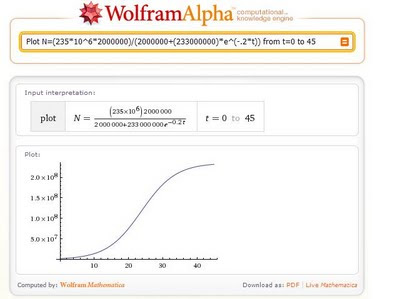
Given that it's said that readership in a blog is reduced by half for every equation posted I'm reluctant to say it but, using calculus, we can determine the rate of change of the population of electric vehicles (that is, how many electric vehicles will be added each year) and determine, at any given time, approximately how much additional demand on the grid will accrue. If we differentiate the equation above (this is kind of backwards in that the logistic equation stems from a differential equation representing the rate of change) we get: d/dt(((235x10^6) 2000000)/(2000000+233000000 e^(-0.2 t))) = (2.1902*^22 e^(-0.2 t))/(233000000 e^(-0.2 t)+2000000)^2. The plot looks like:

At the risk of completely alienating every reader, we can find the maximum rate of addition by taking the second derivative, setting it equal to 0 and solving for t. Plugging this t back into the first derivative and evaluating will give us the maximum rate of addition. But this is such a cascade of estimates that I'll spare the details and just look at the graph. It appears that the maximum rate is about 12,000,000 electric vehicles per year in 2039. That's a long way out and such predictions are obviously fraught with possibilities for error. But I don't know how to do any better.
How much capacity will these 12,000,000 added vehicles per year demand? Let's assume that each vehicle travels 12,000 miles per year and uses 0.2 kilowatt-hours/mile. Further, similarly to the previous post on electric cars linked above, I'm going to assume that the overall efficiency of the transmission and charging systems, we'll need to generate twice what the vehicle uses, or 0.4 kilowatt-hours/mile. So, we'll need to generate 12,000,000 cars*12,000 miles/car/year*0.4 kilowatt-hours/mile=57.6*10^9 kilowatt hours/year. Google's calculator conveniently converts this to 6,570 megawatts or about 6.6 gigawatts of added capacity per year required at the peak. A modern large generating facility will have a nameplate capacity of about a gigawatt so this seems eminently achievable using nuclear power or with the invention of, as my friend Michael likes to say, the boron guy.
It's also clear that it wouldn't be the case that on, say December 31, 2011 there would be almost no electric cars on the road (as today) and on January 1, 2012 all personal vehicles would be electric. Mathematicians have developed several methods that purport to model the adoption and spread of technology. Among these are the logistic function and the Gompertz function. So what might the adoption and market penetration of electric vehicles look like, and how quickly, if at all, would generating capacity need to be added?
In reply to President Obama's call for one million plug in hybrids and electric vehicles, Nissan CEO Carlos Ghosn has stated that this number could be easily surpassed.
Based on a paper concluding that the logistic function best represented the adoption of cellular phones in Taiwan, I'm going look at the logistic function and adjust the coefficients so that the ultimate adoption is 235,000,000 vehicles and 2,000,000 are on the road in 2015. I'll estimate an annual growth rate of 20%. The resulting logistic equation is N = ((235x10^6) 2000000)/(2000000+233000000 e^(-0.2 t)) where N is the total number of electric vehicles and t is the time in years. Using Wolfram Alpha (if you click this link, the equation will already be input, you can change the parameters at will) the plot looks like this:

Given that it's said that readership in a blog is reduced by half for every equation posted I'm reluctant to say it but, using calculus, we can determine the rate of change of the population of electric vehicles (that is, how many electric vehicles will be added each year) and determine, at any given time, approximately how much additional demand on the grid will accrue. If we differentiate the equation above (this is kind of backwards in that the logistic equation stems from a differential equation representing the rate of change) we get: d/dt(((235x10^6) 2000000)/(2000000+233000000 e^(-0.2 t))) = (2.1902*^22 e^(-0.2 t))/(233000000 e^(-0.2 t)+2000000)^2. The plot looks like:

At the risk of completely alienating every reader, we can find the maximum rate of addition by taking the second derivative, setting it equal to 0 and solving for t. Plugging this t back into the first derivative and evaluating will give us the maximum rate of addition. But this is such a cascade of estimates that I'll spare the details and just look at the graph. It appears that the maximum rate is about 12,000,000 electric vehicles per year in 2039. That's a long way out and such predictions are obviously fraught with possibilities for error. But I don't know how to do any better.
How much capacity will these 12,000,000 added vehicles per year demand? Let's assume that each vehicle travels 12,000 miles per year and uses 0.2 kilowatt-hours/mile. Further, similarly to the previous post on electric cars linked above, I'm going to assume that the overall efficiency of the transmission and charging systems, we'll need to generate twice what the vehicle uses, or 0.4 kilowatt-hours/mile. So, we'll need to generate 12,000,000 cars*12,000 miles/car/year*0.4 kilowatt-hours/mile=57.6*10^9 kilowatt hours/year. Google's calculator conveniently converts this to 6,570 megawatts or about 6.6 gigawatts of added capacity per year required at the peak. A modern large generating facility will have a nameplate capacity of about a gigawatt so this seems eminently achievable using nuclear power or with the invention of, as my friend Michael likes to say, the boron guy.
Sunday, November 08, 2009
Energy use and standard of living
I mentioned in my post on the Olduvai theory that, to a large extent, a high standard of living is correlated with a high level of per capita energy use. Using the spreadsheet for Human Development Index from the United Nations here and the spreadsheet for International Primary Energy Consumption from the Energy Information Agency here, I've put together a graphic to show this.
 Here's the display (click to enlarge), with a logarithmic scale of per capita annual energy use in btu on the horizontal axis and the U.N. Human Development Index on the vertical axis. This index attempts to measure human development by life expectancy at birth, knowledge and education measured by adult literacy rate and gross enrollment rates, and economic standard of living as represented by natural logarithm of gross domestic product per capita at purchasing power parity. In the graph, each red square indicates the data from a specific country.
The so-called "coefficient of determination," R^2, of the the scatter plot is about 0.82. This can be interpreted as meaning that per capita energy use explains about 82% of the variation in the Human Development Index (though statisticians will cringe).
This is truly very bad news though. The vast majority of the world's population is concentrated in countries with relatively low measures of human development and low energy consumption. These people justifiably would like to increase their standard of living and their ability to do so will either be constrained by lack of primary energy resources or will cause an enormous increase in "self-poisoning" of the human race.
I'll have more to say about this graph in future posts.
Tuesday, November 03, 2009
Mass and energy
You might have heard of Einstein's famous equation E=mc^2. I would imagine if there is a single equation of any kind, let alone of physics, that a random American could quote, that would be the one. Many who can quote it don't have a grasp of what it means (much as I appreciate E=mc^2, I'd go for F=ma). Of course, it doesn't take much algebra to change E=mc^2 into m=E/c^2.
In the U.S., each year we use about 100 quadrillion btu (100 "quads") of primary energy. This is electricity, fuel for transportation, manufacturing, etc.; that is, for everything. With the handy Google calculator we can determine the mass whose total conversion to energy would supply this amount of energy by simply typing "(100 quadrillion btu)/((3*10^8 meters/second)^2) in kilograms" into a Google search bar (3*10^8 meters/second is the speed of light or "c"). Be careful with the parentheses and groupings or the units won't work out correctly. Google handles all of the unit conversions and returns "(100 quadrillion btu) / ((3 * (10^8) (meters / second))^2) = 1 172.28428 kilograms." That is, conversion of the mass of a small car completely into energy would supply our U.S. energy needs for a year.
Of course, many teams are pursuing the goal of reliable direct conversion of mass into energy using the fusion process. It's said that "fusion is the energy source of the future and always will be."
Sunday, October 25, 2009
Olduvai?
There's a cheery website called "Dieoff" that does a pretty good job of factually presenting the worst case interpretation of demographic, economic, and resource consumption data. A contributor to the site, Richard C. Duncan, Ph.D., is the nominal (he acknowledges the contributions of many others) originator of the so-called "Olduvai Theory" which posits that we're quickly headed for a "post-industrial stone age."
The metric used by Duncan is per capita energy use. It seems to be a reasonable idea - mankind's ability to convert energy at ever-increasing rates has gone hand in hand with increasing standards of living (at least in those societies able to capitalize on it). And ranking of countries by primary energy use looks pretty similar to a ranking by standard of living, though there are exceptions at the high end.
Duncan cites a variety of sources indicating that per capita energy use peaked somewhere in the 1973-1979 time period. It's estimated that peak per capita energy use was about 11.15 boe (barrels of oil equivalent) or 6.46*10^7 BTU. He predicted that per capita energy use would decline at a rate of about 0.33%/year after that. Such a decline would lead to a 2008 per capita use of 10.47 boe or 6.07*10^7 BTU. What's happened?
Using BP's incredible site, the historical data spreadsheet gives me the data I need (by the way, anyone interested in energy, oil, etc. should spend a lot of time on that site). In 2008, per capita consumption was about 6.68*10^7 BTU. This is actually down from a peak of 7.24*10^7 BTU. The drops in 2007 and 2008 were quite steep.
Since the U.S. uses about 25% of primary energy and about five times the average, our effect on such statistics is huge, and we entered a deep recession in 2007. It remains to be seen what trajectory our recovery, if it comes, will take. For this reason, I don't think the current data support the Olduvai theory, at least at the present time.
It's also opined that the developing nations' striving for increased standards of living will overwhelm the developed world's (and particularly the U.S.'s) efforts at efficiency and I think that this is where the constraint will manifest. Since we use about 32.7*10^7 BTU per capita per year, a little less than five times the average, it's not likely we can find a way to bring the rest of the world to our level of use. And this takes no account of any peak oil consideration.
I've included a graph showing world population, total energy use, and world per capita annual energy use from 1980 through 2008. Click on it to see a larger and clearer version. Note the precipitous drop in the latter two categories in 2007 and 2008.

Friday, October 23, 2009
Modeling
Many of the comments I've seen "debunking" the science behind climate change are based on criticism of "computer models." Such people need to stay off of bridges and out of buildings, cars, ships, and airplanes. All are now designed using computer models. So, just what is a computer model, what can one do, when is one useful, and how can one go wrong?
Let's start with "what is a model?" When a net force acts on an object, that object accelerates. We learn in high school (and I've used repeatedly in this blog) that "F=ma." This constitutes, in a broad sense, a model. After all, the universe is not a calculator and F=ma is a synthesis of the way people (starting before Newton) believe material objects behave. It's been found to be useful and successful but may need to be modified, for example, in situations where the general theory of relativity is applicable.
As it happens, simulations using this model can be run on pencil and paper, with slide rules, or with a calculator. Nevertheless, the equation takes our best understanding of the essentials of a physical principle and, given specific input, will provide predictions of the output. But here's the point: science is about modeling. The world is too complex to track and measure every degree of freedom.
The spreadsheet I used to analyze acceleration is also a model. Again, it involves assumptions, separation of what I believed to be essential vs. non-essential parameters, measurements, and estimates. Like all models, it's subject to error if I've made a mistake in any of these components.
How do I check? In such a simple model, it's fairly straightforward. Does it make sense? How do the orders of magnitude compare? Does it provide reasonable numbers in limiting cases? Does it make predictions that match measured results? In my case, I believe the answers to this question is "yes, to within the accuracy that I can measure."
So what about computer modeling of climate? The models are built by doing what I did for the acceleration of my car, i.e., culling non-essential (or non-measurable) parameters, applying basic physical principles (Newton's Laws, conservation laws, thermodynamic laws, transport and transfer laws, etc.) to initial conditions, and evaluating the output. Like my model, it's an iterative process - the model is tested with input conditions for which output conditions are known and a determination if adjustments are required is made.
Of course, the more assumptions included and the larger the input data set, the more complex (and potentially though not necessarily the more accurate) is the model. The so-called "global circulation models" (GCM's) are quite complex. But as with any model, confidence in their accuracy is gained by comparison with known initial and final conditions. Here is a summary of successes of the GCM's.
The point here is that naive criticism of the process of modeling is completely misguided. Such critics use the results of successful "computer modeling" every day. If one wishes to criticize the models, it must be based on the factors above: wrong choice of parameters; inaccurate measurement of initial conditions, etc. "How can we believe a computer model?" is a question indicative of blissful ignorance. As stated (and demonstrated) in the post cited above, there are improvements to be made, but the current state of the art appears to be very good. And when it comes to physics, models are all we have.
Saturday, October 17, 2009
Is there a psychologist in the house?
Just kidding, my regard for the so-called "soft sciences" is pretty low, though my father was a psychologist. But I'm trying to understand a guy like Marc Morano. Amazingly, Mr. Morano has no Wikipedia entry, so I'm tempted to think he doesn't actually exist. But he's the driving force behind the Climate Depot web site, an aggregator of anthropogenic global warming ("AGW") denial (or skeptic, take your pick) stories modeled very much after the Drudge Report.
Morano was an early promulgator of the Swift Boat Veterans' attacks on John Kerry and has worked for Rush Limbaugh. I've watched Morano in several debates and he's a quick witted and intelligent man and he very clearly has his facts in hand. So what does this man believe? I know what he contends but what does he believe?
I see several possibilities: he's a true believer that AGW is false but thinks those who claim it to be true genuinely believe that it is; he believes it's false and that the professed believers know it's false and are using it as a trojan horse for control of the world's economy; he believes AGW is true but thinks those who pay him really think it's false and he wants to continue to get paid; he believes AGW is true and that his income comes from people who also know it's true but whose economic interests are more important or who think that the consequences of action against AGW are worse than the consequences of warming; and several more possibilities.
Suppose he really is a true believer. I came to the issue leaning toward acceptance of AGW and severe negative consequences but had doubts. Among other sites, my friend Michael Tobis' Only In It For The Gold web site and links and papers therefrom have led me to be fairly firmly in the "it's warming, it's us, it's bad" camp though reading the guys below and the comments on their blogs occasionally still causes doubt to creep in - this is just not my area of specialist expertise. Though I've taken a lot of physics courses I'm no physicist, and though my college major was math and I'm working on an M.S. in Applied Mathematics, I'm no mathematician. I doubt I'm smarter than Morano and I certainly don't have the time he does to devote to the issue. So how can it be that he's a true believer? Is it truly a matter of his being slavishly beholden to his philosophy?
I want to understand Morano, Anthony Watts of Watts Up with That?, Steve McIntyre of Climate Audit and others. I'm not sure it would help in the battle for the hearts and minds of the public and the politicians, but it certainly couldn't hurt to know what's really going on in the minds of these highly popular and influential bloggers.
And I thought my disdain for Bill Maher couldn't get any deeper
My comments about Maher tend to be so vituperative that they don't pass moderation even on blogs whose viewpoints I generally support and when Maher is espousing an opinion with which I agree (admittedly rare), e.g., my first comment at ClimateSight.
But here we find him telling pregnant women not to get the H1N1 ("swine flu") vaccine. And he not only repeats lame pseudoscientific claptrap ("Western Medicine misses a lot") but makes inane factual misstatements (i.e., "lies"). For example, he states that the injected vaccine is a live virus. It is not. If one pregnant woman sees his screed and consequently avoids the vaccine, contracts the disease, and dies, as far as I'm concerned it is depraved indifference tantamount to negligent homicide.
But here we find him telling pregnant women not to get the H1N1 ("swine flu") vaccine. And he not only repeats lame pseudoscientific claptrap ("Western Medicine misses a lot") but makes inane factual misstatements (i.e., "lies"). For example, he states that the injected vaccine is a live virus. It is not. If one pregnant woman sees his screed and consequently avoids the vaccine, contracts the disease, and dies, as far as I'm concerned it is depraved indifference tantamount to negligent homicide.
Monday, October 12, 2009
More on efficiency
The spreadsheet I created for my recent post on acceleration has enough data to enable me to make another estimate of the overall efficiency of my transportation system (the Land Rover LR3 HSE) during the acceleration phase. This is because I have a tenth of a second by tenth of a second tabulation of energy used to accelerate and to overcome external forces as well as a tabulation of the fuel used.
Summing the fuel and knowing the heat energy available in the amount burned and summing the energy expended to do useful work and dividing yields the answer: 21.0% using the 45 seconds to 55 m.p.h. regime and 22.7% using the 10 seconds regime. This is actually a little better than I would have imagined. I typically calculate cruise figures estimating 25%, but I'd have thought that accelerating from a dead stop would have a larger negative impact on efficiency. Admittedly, it's a long chain from the data I actually have obtained to the figures I've calculated and the weakest link is my use of a composite engine map adjusted with only a very few points from my specific car but as I've said repeatedly, I love it when multiple lines of data and/or reasoning converge.
If my car required half as much energy through weight and drag reductions and was twice as efficient, I'd use one fourth my current fuel. If we all did.....
Thursday, October 08, 2009
Can we "go electric"?
I'm sure it's been covered elsewhere on the web, but since James Kunstler has declared that we won't be able to keep the transportation system he refers to as "happy motoring," I thought I'd point my brand of quick and dirty calculating at the situation.
I'll start at the Energy Information Administration page here. This site is a gold mine of information for sources and sinks of energy of all kinds, for not only the United States but for the world. We find that in 2008, 8,989,000 barrels of "finished motor gasoline" was supplied in the U.S. per day on average. This represents 4.72*10^16 joules of heat energy of which I'll assume that 22%, or 1.04*10^16 joules are translated to force applied to the earth by tires to do the work of moving a vehicle down the road.
Using estimates from this post of 85% efficiency of chargers and 60% efficiency of transmission, 50% of the energy developed at a power plant winds up in a battery. Electric motors are pretty efficient, Tesla claims 86%. I'm going to go with 85%.
Since this is very rough, I'm going to assume that the vehicles replacing the gasoline vehicles are equally efficient, thus enabling me to merely look at joules at the wheel. Therefore, I need 1.04*10^16/(0.6*0.85) or 2.04*10^16 joules/day. This is energy divided by time, or power and using google's calculator, it equates to 2.36*10^11 watts or 236,000 megawatts.
The current generating capacity of the U.S., according to the EIA, is about 1.05 million megawatts (a little over a terawatt). This is just a little bit below the so-called "generator nameplate capacity" of the generating facilities. In 2007, we used electrical energy at a rate equivalent to about 464,000 megawatts, so adding a need for another 236,000 megawatts (increasing utilization by over 50%) would seem to be problematic. The difference between the actual rate of use and total capacity represents down time for maintenance, peak capacity, etc. and thus is not simply idle generating capacity looking for a use.
To maintain the same ratio of actual usage rate to capacity we'd need to add over 500,000 megawatts of generating capacity. That's a whale of a lot of solar panels and windmills. Or, since an average nuclear generating facility has a nameplate capacity of about 1,000 megawatts, we'll need about 500 of those. Best we had get started.
And of course, this says nothing about the transmission of all this electrical energy via a grid that is currently limping along at best, nor does it address the resources required to set up the infrastructure for such an increase in capacity. While I certainly have my gripes with Kunstler, it's true that simply switching to electric cars is no magic bullet for our peak oil predicament.
Update: an ultra-quick "back of the envelope" calculation indicates that we'd have to cover about 7.4% of the state of Arizona with solar panels to supply this extra electrical energy. Of course, storage might be an issue and I'm not so sure that condemnation of the southern eighth of the state (the extra area needed for storage, switching, support, etc.) via eminent domain would be well received.
Subscribe to:
Posts (Atom)