I am by nature a cynical and pessimistic person (not the same thing - it's said that an optimist is a father who will loan his teenager the car, a pessimist is one who won't, and a cynic is one who did). I don't say this to brag, I actually try to at least act as if I'm not. This blog covers topics that will, if major changes aren't forthcoming (and there's no reason to believe they will be), result in unprecedented trauma in our so-called social contract. Now, maybe we'll adapt and the result will be a stable and sustainable societal arrangement, albeit at a lower level of energy conversion. Maybe it will be a Mad Max world. I'd like to hope the former, but my makeup makes me dubious.
Thus, it's significant to me when I find something that makes me feel that it's not all bad. A few months ago, I was watching a youtube video of Leo Kottke, a guitarist I've admired for years and seen on multiple occasions. Youtube suggested I might want to see videos featuring Tommy Emmanuel, of whom I'd never heard. I didn't click on them for the first few times they came up next to Leo, but I finally did. Let me say that Tommy's talent, skill, and love of music have become one of the things that makes me believe there's good in the world and things worth preserving.
I drove four and a half hours to see Tommy Emmanuel perform in Exeter, CA and, though I anticipated that it would be a wonderful experience, I tremendously underestimated how moving it would be. His videos are all over youtube and, since this is a non-commercial blog, I've decided to put one here. It's called "Those Who Wait." I apologize in advance for no physics, vehicle, energy, or gasoline content but I feel compelled to share my wonder at this uniquely talented and genuinely beautiful musician and songwriter (the composition featured here is his). Click on it, you'll thank me. If you're wondering if he's capable of something a little more up-tempo, check out his Guitar Boogie. If your jaw doesn't hit the floor, you have more self-control than I.
Saturday, August 08, 2009


Sunday, August 02, 2009
Why "Hamiltonian Function"?
Physicists (of which I am most emphatically not one) will instantly recognize the "Hamiltonian." It's not about a horse race (though I stuck "function" on in the name to distinguish it from that) nor does it refer to a Founding Father. Rather, the Hamiltonian is a function that represents the total energy of a system utilizing a reformulation of Newtonian mechanics called, unsurprisingly, Hamiltonian mechanics. Since this blog is nominally about energy, how to minimize its expenditure, and take maximum advantage the energy I convert, the Hamiltonian Function as a title seems appropriate to me.
Though it typically doesn't make a particular problem easier to solve, it's considered that the Hamiltonian of a system is capable of providing deeper insight into the nature of the system under consideration than the second order differential equations of Newtonian mechanics. This is particularly true when the system involves quantum mechanical considerations, though it is completely general in its application. I'd be flattering myself to contend that my little blog is capable of providing deep insights, but I do hope that it can provide a different point of view and be thought provoking.
Though it typically doesn't make a particular problem easier to solve, it's considered that the Hamiltonian of a system is capable of providing deeper insight into the nature of the system under consideration than the second order differential equations of Newtonian mechanics. This is particularly true when the system involves quantum mechanical considerations, though it is completely general in its application. I'd be flattering myself to contend that my little blog is capable of providing deep insights, but I do hope that it can provide a different point of view and be thought provoking.
Playing with an iPhone
I dumped my forever locking up Samsung Omnia for an iPhone 3Gs. As most will know, one of the major selling points of the iPhone (and a good one at that, though some stridently disagree) is the availability of an ever-growing "app store." I've installed six apps so far, but this post is about the Wavefront Labs Accelerator Data Pro and Cross-Discipline Technology, LLC Gforce apps. These apps take the data from the three axis accelerometer in the iPhone and display it or log it. I thought it would be interesting to document exactly how slowly I accelerate, though I already had a pretty good idea from logging speed vs. time in five second intervals as mentioned in this post.
 I've used the Gforce app more frequently because, well, I'm driving and the display is much more intuitive to understand at a glance (click on the photo for an enlarged view). It's capable of holding the peak in longitudinal and transverse axes for a user-set amount of time and of sounding an alarm when user-set limits are exceeded in either axis. The Acceleration Data Pro is capable of saving data to a file and exporting for subsequent analysis. I intend to so use it but have not done so yet.
As readers of this blog might imagine, my positive acceleration numbers are quite small, rarely exceeding 0.1 g (0.98 meters/sec^2), though the first movement from a stop is typically about 0.15 g. I estimate that the average acceleration up to speed is about 0.055 g. To get a feel for this, that means I'm gaining about 1.2 miles/hour in speed with each second. Using that acceleration, I get to 55 miles/hour in about 45.6 seconds. This is somewhat faster than the results I got from timing, referred to above. I don't know if I'm getting more rambunctious in my application of throttle (doubtful, judging from the reactions of those with whom I share the road) or I'm "guesstimating" the average acceleration from the iPhone inaccurately.
Probably of more interest, there's a curved ramp from the 605 freeway northbound to the 91 freeway eastbound that I take at a speed, v, of about 50 miles/hour (22.35 meters/second). The Gforce shows a centripetal acceleration, a, of about 0.38 g, or 3.724 meters/second^2. Now, since a=v^2/r, where r is the radius of the path described by my vehicle (for a very nice lesson on this topic, see Rhett Alain's Dot Physics entry), I can estimate that the radius of the ramp is about 134 meters. How can you not love the ability of the iPhone to measure the radius of curvature of a freeway on-ramp?
The ramp has a recommended maximum speed of 35 miles/hour (I maintain 50 m.p.h. because I don't want to apply brakes). Working backwards, this means that CalTrans has designed the ramp for a recommended centripetal acceleration of about 0.19 g. They should put that on the sign!
Starting early in my first high school physics class and reemphasized ever since, when looking at any physical situation, when in doubt, F=m*a. That is, force equals mass times acceleration, Newton's second law (well, sort of - Newton actually framed it as net force equals rate of change of momentum but it's the same thing). Let's apply it here. The mass of my Land Rover LR3 HSE is about 2,676 kilograms, and I take that curve at about 0.38 g or 3.72 meters/second^2. This means F is about 9966 Newtons, or about 2,240 pounds. Note that this is over 10 times the force required to move the LR3 down the road at 55 m.p.h. and it's applied by the road to the vehicle through the tires. No wonder they wear out!
Update: To really see what can be done with the iPhone and its acclerometer and GPS, see Michael Koppelman's exploits with an iPhone in a model rocket.
Update 2: I haven't done any programming since about 1989, and that was meager. My last (semi) serious bout with programming was in 1980. I wonder how hard it would be to write and install a program for the iPhone that would provide average acceleration in each axis from a start to a stop time, or average over user set intervals, say, every second?
 I've used the Gforce app more frequently because, well, I'm driving and the display is much more intuitive to understand at a glance (click on the photo for an enlarged view). It's capable of holding the peak in longitudinal and transverse axes for a user-set amount of time and of sounding an alarm when user-set limits are exceeded in either axis. The Acceleration Data Pro is capable of saving data to a file and exporting for subsequent analysis. I intend to so use it but have not done so yet.
As readers of this blog might imagine, my positive acceleration numbers are quite small, rarely exceeding 0.1 g (0.98 meters/sec^2), though the first movement from a stop is typically about 0.15 g. I estimate that the average acceleration up to speed is about 0.055 g. To get a feel for this, that means I'm gaining about 1.2 miles/hour in speed with each second. Using that acceleration, I get to 55 miles/hour in about 45.6 seconds. This is somewhat faster than the results I got from timing, referred to above. I don't know if I'm getting more rambunctious in my application of throttle (doubtful, judging from the reactions of those with whom I share the road) or I'm "guesstimating" the average acceleration from the iPhone inaccurately.
Probably of more interest, there's a curved ramp from the 605 freeway northbound to the 91 freeway eastbound that I take at a speed, v, of about 50 miles/hour (22.35 meters/second). The Gforce shows a centripetal acceleration, a, of about 0.38 g, or 3.724 meters/second^2. Now, since a=v^2/r, where r is the radius of the path described by my vehicle (for a very nice lesson on this topic, see Rhett Alain's Dot Physics entry), I can estimate that the radius of the ramp is about 134 meters. How can you not love the ability of the iPhone to measure the radius of curvature of a freeway on-ramp?
The ramp has a recommended maximum speed of 35 miles/hour (I maintain 50 m.p.h. because I don't want to apply brakes). Working backwards, this means that CalTrans has designed the ramp for a recommended centripetal acceleration of about 0.19 g. They should put that on the sign!
Starting early in my first high school physics class and reemphasized ever since, when looking at any physical situation, when in doubt, F=m*a. That is, force equals mass times acceleration, Newton's second law (well, sort of - Newton actually framed it as net force equals rate of change of momentum but it's the same thing). Let's apply it here. The mass of my Land Rover LR3 HSE is about 2,676 kilograms, and I take that curve at about 0.38 g or 3.72 meters/second^2. This means F is about 9966 Newtons, or about 2,240 pounds. Note that this is over 10 times the force required to move the LR3 down the road at 55 m.p.h. and it's applied by the road to the vehicle through the tires. No wonder they wear out!
Update: To really see what can be done with the iPhone and its acclerometer and GPS, see Michael Koppelman's exploits with an iPhone in a model rocket.
Update 2: I haven't done any programming since about 1989, and that was meager. My last (semi) serious bout with programming was in 1980. I wonder how hard it would be to write and install a program for the iPhone that would provide average acceleration in each axis from a start to a stop time, or average over user set intervals, say, every second?
Tuesday, July 28, 2009
Getting from here to there
My previous post dealt with business jets. It was discouraging in that for a lot of money, you purchase the opportunity to use a lot of fuel on very expensive trips. I didn't get into so-called "direct operating costs" which include such items as engine inspection/overhaul reserve, maintenance, pilot costs (for a professional), etc. not to mention hangaring, insurance, and more, but suffice it to say that these aren't trivial for a "bizjet."
So who flies on a bizjet and why? And, for the matter of that, how should I decide how to get from here to there? I determined to apply logic and spreadsheets to the questions. I decided that the relevant factors are: speed; convenience; cost; and fuel (carbon). I subdivided convenience into: location near departure point and destination; security check hassles; schedule convenience; schedule reliability; and baggage limitations. I rated five methods of getting from here to there: airlines; my Land Rover LR3 HSE; the Phenom 100 of the previous post; my Saratoga; and an intercity bus. Sadly, having investigated intercity rail for a couple of trips, for most purposes that mode is completely impractical. There are exceptions of course, for example, downtown Los Angeles to downtown San Diego.
For each analyzed mode I used various numbers - some objective (e.g., speed, fuel economy) and some subjective (e.g., convenience) and scaled the rating for each transportation method in each category with the best rated in the category as "1." Then I assigned weights to each factor and summed them to determine a "merit index" for each mode of transport. I then played with the weights to see what considerations would result in which mode being the preferred choice.
For me, on an intermediate length business trip (say, Long Beach to Salt Lake City), I figured the weighting factors to be: speed - 0.4; convenience - 0.25; cost - 0.25; fuel burn (carbon emitted) - 0.1. Using these, the airline trip has the highest merit index, followed by the LR3, the Phenom 100, the bus, and finally the Saratoga. This is most interesting, in that I made just such a trip a few weeks ago and took the Saratoga.
So what weights result in choosing the Saratoga? If the biggest factor is convenience followed by speed as about half as important, cost of little importance and fuel of trivial importance, the Saratoga wins. Similarly, if speed and convenience are the only factors and speed is half again as important as convenience, the Phenom 100 is the way to go. Note that this literally means "money and fuel are no object, get me there fast and easily."
Looking for a combination resulting in driving being the choice, convenience dominates with everything else relatively minor. I'm in no hurry, not too concerned about cost and fuel. Finally, what would motivate me to take the bus? If my main concern is fuel burn and minimizing carbon footprint, with convenience and speed not among my considerations (not to mention how I smell when I arrive) then the bus is my choice.
It's clear that this analysis is of limited practical applicability - I certainly wouldn't take a bus or drive to New York City, nor take my Saratoga to Glendale, CA. And to call the methodology simplistic would be an insult to simpletons. Furthermore, it leaves out the "because I wanted to" factor that motivates the Saratoga trips. I'm suspicious that such a factor may also be operative in many bizjet flights. It's built around a typical business trip for my company, say, to Phoenix, Sacramento, Salt Lake City, etc. But even at that, it provides a valid comparison for bizjet vs. airline to New York or Saratoga vs. driving to Las Vegas.
The biggest revelation coming from this exercise is the wide range of considerations that lead to the airline being the preferred choice. Obviously nothing earth shattering, but it has helped me to crystallize my thoughts and to understand how I'd have to rationalize... er... justify... ummm that is, what considerations would have to be most important for me to make the purchase of a bizjet something I "couldn't afford not to do."
So who flies on a bizjet and why? And, for the matter of that, how should I decide how to get from here to there? I determined to apply logic and spreadsheets to the questions. I decided that the relevant factors are: speed; convenience; cost; and fuel (carbon). I subdivided convenience into: location near departure point and destination; security check hassles; schedule convenience; schedule reliability; and baggage limitations. I rated five methods of getting from here to there: airlines; my Land Rover LR3 HSE; the Phenom 100 of the previous post; my Saratoga; and an intercity bus. Sadly, having investigated intercity rail for a couple of trips, for most purposes that mode is completely impractical. There are exceptions of course, for example, downtown Los Angeles to downtown San Diego.
For each analyzed mode I used various numbers - some objective (e.g., speed, fuel economy) and some subjective (e.g., convenience) and scaled the rating for each transportation method in each category with the best rated in the category as "1." Then I assigned weights to each factor and summed them to determine a "merit index" for each mode of transport. I then played with the weights to see what considerations would result in which mode being the preferred choice.
For me, on an intermediate length business trip (say, Long Beach to Salt Lake City), I figured the weighting factors to be: speed - 0.4; convenience - 0.25; cost - 0.25; fuel burn (carbon emitted) - 0.1. Using these, the airline trip has the highest merit index, followed by the LR3, the Phenom 100, the bus, and finally the Saratoga. This is most interesting, in that I made just such a trip a few weeks ago and took the Saratoga.
So what weights result in choosing the Saratoga? If the biggest factor is convenience followed by speed as about half as important, cost of little importance and fuel of trivial importance, the Saratoga wins. Similarly, if speed and convenience are the only factors and speed is half again as important as convenience, the Phenom 100 is the way to go. Note that this literally means "money and fuel are no object, get me there fast and easily."
Looking for a combination resulting in driving being the choice, convenience dominates with everything else relatively minor. I'm in no hurry, not too concerned about cost and fuel. Finally, what would motivate me to take the bus? If my main concern is fuel burn and minimizing carbon footprint, with convenience and speed not among my considerations (not to mention how I smell when I arrive) then the bus is my choice.
It's clear that this analysis is of limited practical applicability - I certainly wouldn't take a bus or drive to New York City, nor take my Saratoga to Glendale, CA. And to call the methodology simplistic would be an insult to simpletons. Furthermore, it leaves out the "because I wanted to" factor that motivates the Saratoga trips. I'm suspicious that such a factor may also be operative in many bizjet flights. It's built around a typical business trip for my company, say, to Phoenix, Sacramento, Salt Lake City, etc. But even at that, it provides a valid comparison for bizjet vs. airline to New York or Saratoga vs. driving to Las Vegas.
The biggest revelation coming from this exercise is the wide range of considerations that lead to the airline being the preferred choice. Obviously nothing earth shattering, but it has helped me to crystallize my thoughts and to understand how I'd have to rationalize... er... justify... ummm that is, what considerations would have to be most important for me to make the purchase of a bizjet something I "couldn't afford not to do."
Sunday, July 26, 2009
Just how bad are business jets?
As regular readers will know, I'm a pilot and the owner of a Piper Saratoga. That's a single engine propeller driven aircraft. In it, I get on the order of 11 statute miles per gallon and cruise at around 190 miles per hour. With no headwind, I can fly from my base in Long Beach, CA to Colorado Springs to see my brother and his family without a fuel stop, though I can rarely fly back non-stop. Like most pilots ("most" meaning, I would guess, greater than 95%) I wouldn't mind flying something faster, quieter, and with greater range. I'll also add more comfort (pressurization) and more all-weather capability (fully deiced) to the wish list.
In the current economic situation, traveling in business jets has become a very guilty pleasure indeed - witness the opprobrium heaped upon the GM and Chrysler executives who took their corporate jets to Washington to plead for bail out money. Suitably chastened by the Congressional panelists - who never waste taxpayer money - they drove hybrids to their next Congressional begging session. In the end, however, both companies entered and exited bankruptcy. I'm sure the executive jets were the proximate cause. So, are private jets really so bad?
 Yesterday I had a chance to catch a ride in an Embraer Phenom 100, a so-called "very light jet." It's certificated for single pilot operation, and operates up to 41,000 feet, above almost all weather, at about 415 miles per hour. At that speed its two Pratt & Whitney PW617F-E turbofans burn about 704 pounds of Jet A fuel per hour, delivering a fuel economy of about 4 miles per gallon. Its full fuel range (with full fuel you'll be able to carry about 580 pounds of passengers and baggage not including the pilot) is about 1,400 statute miles in no-wind conditions.
 The Phenom 100 cabin is quite comfortable; a passenger could sleep, work, converse comfortably with associates, or listen to Sirius satellite radio. It treats its passengers as those who get around in business jets expect to be treated (or, not being such a person, so it seems to me). Admittedly, it lacks the quiche heater and bidet one finds in higher end jets, but the interior was designed by BMW Group DesignworksUSA so you won't need to apologize for it. It has six seats - two in the cockpit and four in the cabin, plus a potty that can be used as a seventh seat. Assuming that the pilot is a professional, the five remaining seats mean that the aircraft can deliver something like 20 passenger seat miles per gallon. If I'm the pilot and I have five passengers, the figure is 24 seat miles per gallon. You'll have to queue up to purchase yours for about $3.6M.
Now, were my blog to catch on, the ad revenues to flow like water, and my bank account to swell like a balloon, I've always felt that the best, fastest, longest range airplane FLYABLE BY A SINGLE PILOT would be my ultimate ride. It's a short list of candidates and the Phenom 100 would be on it. Just how bad is this in terms of fuel consumption? In 2008, it's estimated that U.S. air carriers delivered about 58 seat miles per gallon. The Boeing 737-800 gets about 80 seat miles per gallon. If I look at my Land Rover LR3 as a five seat vehicle, I'm currently getting about 105 seat miles per gallon, though for 95% of the miles, I'm getting 21 passenger miles per gallon. Were I to use the Phenom 100 as I use my Saratoga it also would have a single occupant for the vast majority of its flight hours, thus providing four passenger miles per gallon.
I have to concede that this is a depressing post. It's difficult for me to enumerate these facts and then desire to purchase a jet. By no means am I financially able to contemplate such a purchase at this point anyway, but it had been nice to dream.
In the current economic situation, traveling in business jets has become a very guilty pleasure indeed - witness the opprobrium heaped upon the GM and Chrysler executives who took their corporate jets to Washington to plead for bail out money. Suitably chastened by the Congressional panelists - who never waste taxpayer money - they drove hybrids to their next Congressional begging session. In the end, however, both companies entered and exited bankruptcy. I'm sure the executive jets were the proximate cause. So, are private jets really so bad?
 Yesterday I had a chance to catch a ride in an Embraer Phenom 100, a so-called "very light jet." It's certificated for single pilot operation, and operates up to 41,000 feet, above almost all weather, at about 415 miles per hour. At that speed its two Pratt & Whitney PW617F-E turbofans burn about 704 pounds of Jet A fuel per hour, delivering a fuel economy of about 4 miles per gallon. Its full fuel range (with full fuel you'll be able to carry about 580 pounds of passengers and baggage not including the pilot) is about 1,400 statute miles in no-wind conditions.
 The Phenom 100 cabin is quite comfortable; a passenger could sleep, work, converse comfortably with associates, or listen to Sirius satellite radio. It treats its passengers as those who get around in business jets expect to be treated (or, not being such a person, so it seems to me). Admittedly, it lacks the quiche heater and bidet one finds in higher end jets, but the interior was designed by BMW Group DesignworksUSA so you won't need to apologize for it. It has six seats - two in the cockpit and four in the cabin, plus a potty that can be used as a seventh seat. Assuming that the pilot is a professional, the five remaining seats mean that the aircraft can deliver something like 20 passenger seat miles per gallon. If I'm the pilot and I have five passengers, the figure is 24 seat miles per gallon. You'll have to queue up to purchase yours for about $3.6M.
Now, were my blog to catch on, the ad revenues to flow like water, and my bank account to swell like a balloon, I've always felt that the best, fastest, longest range airplane FLYABLE BY A SINGLE PILOT would be my ultimate ride. It's a short list of candidates and the Phenom 100 would be on it. Just how bad is this in terms of fuel consumption? In 2008, it's estimated that U.S. air carriers delivered about 58 seat miles per gallon. The Boeing 737-800 gets about 80 seat miles per gallon. If I look at my Land Rover LR3 as a five seat vehicle, I'm currently getting about 105 seat miles per gallon, though for 95% of the miles, I'm getting 21 passenger miles per gallon. Were I to use the Phenom 100 as I use my Saratoga it also would have a single occupant for the vast majority of its flight hours, thus providing four passenger miles per gallon.
I have to concede that this is a depressing post. It's difficult for me to enumerate these facts and then desire to purchase a jet. By no means am I financially able to contemplate such a purchase at this point anyway, but it had been nice to dream.
Saturday, July 18, 2009
Powerkuff
 In May, I attended the Cleantech conference in Houston, TX. While at one of the sessions, a presenter made a passing remark (and held his example up for us to see) about the "Powerkuff." This simple device wraps around the electrical service to my house at the service panel and wirelessly sends a continuous stream of data on power use. Added to information on price, it allows me to see just how much electricity is being used and how much money is being spent.
 The device is fairly foolproof, and the output can be read on a small box and sent to a proprietary program through a USB port to a graphical display on the computer, showing power as a function of time. It comes complete and shipped for about $109, and the software to upload usage data to my computer is a free download on the Powerkuff web site. And Chuck Wagner is very helpful and accessible. The software is quite rudimentary, data cannot be stored or output to Excel. But it's still quite interesting.
For example, my "base power" right now (no A/C, no pool pump, electric stove and oven off, etc.) appears to be about 2.1 kilowatts. That's right, the refrigerator plus the various "phantom loads" (Direct TV boxes, DVD players, PS3, televisions, clocks, etc.) are sucking electrical energy and turning it into heat and light and coldness at the rate of 2100 joules/second (2.1 kilowatts). Yikes! In a year, this will amount to over $2,000 just to have food cold and entertainment "ready to go." This needs some rethinking.
With the A/C and pool pump on in the daytime, we're looking at about 7.5 kilowatts. Wow! I've mentioned in a previous post that I estimate my family's use of energy to be equivalent to about 40 kilowatts. This includes vehicles, food, "stuff," electricity at home and work, etc. I had estimated my average continuous use of electrical energy in the house at about 2.8 kilowatts. Now, I'm not so sure. The pool pump goes year around (though not continuously - about six hours per day). Obviously the A/C doesn't but still, I think I may have underestimated.
I live in Anaheim, CA where electricity is provided by Anaheim Public Utilities at relatively reasonable rates and yet I must be spending at least $3,000/year on electricity. It's clearly time to start the same process for my house that I've engaged in with my car. This will certainly be a more difficult undertaking, but the payoff in savings and in CO2 reduction dictates that I undertake it forthwith. I could have gotten the information above by checking the meter and the bill, but like the ScanGauge II I use in my car, the Powerkuff makes it easy and fun to monitor home electrical energy use.
Update: A somewhat frustrating aspect of the Powerkuff is that one must remove the cover of the sensor with a screwdriver to change the three AA batteries. Further, the only way to turn the sensor off is to remove the batteries (or at least a battery). And if you monitor for extended periods, you will be doing a LOT of battery changing. Admittedly, there's a transformer and AC power input so that the unit can be plugged in. But I suspect that, like me, most people don't have an electrical outlet near their service panel.
One could go through a set of batteries every day at a cost of, say, $5. Needless to say, the Powerkuff won't help you save electricity at a rate such as to justify this. I tried using rechargeable batteries (1.2 V NiMH) but they're good for only a few hours, or even less.
The sensor unit needs a switch so that it can easily be turned on when information is being sought and turned off when attention isn't being paid. As I mentioned above, the data can't be stored anyway. Better still would be the ability to turn it off remotely, either from the display unit or the computer. Should I decide that the Powerkuff is something I need to keep, (which is up in the air due to this issue) I'll probably have the power supply wired into the unit from the service panel.
Sunday, July 12, 2009
The low hanging fruit
I've been driving to maximize fuel economy (minimize fuel consumption) and keeping detailed records of the effort for almost four years. I've been blogging about this and related topics for over three years. I've done all this while driving what would be considered "gas guzzlers." Some may scoff at such efforts, and the following is not meant to encourage people to trade in their fuel sippers for SUV's with big engines.
But I'm driving a vehicle (the Land Rover LR3 HSE) that is EPA estimated to achieve 16 m.p.g. combined. This is pretty close too, in the early days of driving it when I gave up on hypermiling attempts and drove it normally, that was about what I got. I now have a 10 tank and combined moving average of 21 m.p.g. A five m.p.g. difference, big deal, you say. Ah, but it is.
We discuss m.p.g., but the key here is g.p.m., the inverse. In a typical 10,000 mile year, at 16 m.p.g., a vehicle would use 625 gallons of fuel. At 21 m.p.g., it uses 476 gallons, 149 gallons less. If you're currently in a vehicle that gets 30 m.p.g., you'd have to drive in such a way as to achieve 54.2 m.p.g. to save a similar amount of fuel. And each of those saved gallons means about 19 pounds of carbon dioxide is not emitted.
If a driver can change his or her habits to increase mileage from 14 m.p.g. to 15 m.p.g., in a 10,000 mile year that driver will save approximately the same number of gallons as a driver who increases mileage from 25 m.p.g. to 28.4 m.p.g.
The point here is not to justify gas guzzlers, nor is it to pat myself on the back. Rather, it is to point out that there are an awful lot of gas guzzlers on the road, and they are the "low hanging fruit" for fuel savings. Unfortunately, few of the drivers of such vehicles share my craving for maximum fuel economy so the trick is in getting people on board this fruit truck.
And the same rationale that applies to individual drivers applies to car companies as well. Dramatically more fuel is saved if Ford improves the mileage of 20,000 pickup trucks from 14 m.p.g. to 17 m.p.g. than if they change the mileage of 20,000 compact cars from 32 m.p.g. to 35 m.p.g. I know that I'm not the first to come to this realization, but I think it receives far too little attention in the hypermiling and fuel economizing communities.
But I'm driving a vehicle (the Land Rover LR3 HSE) that is EPA estimated to achieve 16 m.p.g. combined. This is pretty close too, in the early days of driving it when I gave up on hypermiling attempts and drove it normally, that was about what I got. I now have a 10 tank and combined moving average of 21 m.p.g. A five m.p.g. difference, big deal, you say. Ah, but it is.
We discuss m.p.g., but the key here is g.p.m., the inverse. In a typical 10,000 mile year, at 16 m.p.g., a vehicle would use 625 gallons of fuel. At 21 m.p.g., it uses 476 gallons, 149 gallons less. If you're currently in a vehicle that gets 30 m.p.g., you'd have to drive in such a way as to achieve 54.2 m.p.g. to save a similar amount of fuel. And each of those saved gallons means about 19 pounds of carbon dioxide is not emitted.
If a driver can change his or her habits to increase mileage from 14 m.p.g. to 15 m.p.g., in a 10,000 mile year that driver will save approximately the same number of gallons as a driver who increases mileage from 25 m.p.g. to 28.4 m.p.g.
The point here is not to justify gas guzzlers, nor is it to pat myself on the back. Rather, it is to point out that there are an awful lot of gas guzzlers on the road, and they are the "low hanging fruit" for fuel savings. Unfortunately, few of the drivers of such vehicles share my craving for maximum fuel economy so the trick is in getting people on board this fruit truck.
And the same rationale that applies to individual drivers applies to car companies as well. Dramatically more fuel is saved if Ford improves the mileage of 20,000 pickup trucks from 14 m.p.g. to 17 m.p.g. than if they change the mileage of 20,000 compact cars from 32 m.p.g. to 35 m.p.g. I know that I'm not the first to come to this realization, but I think it receives far too little attention in the hypermiling and fuel economizing communities.
Friday, July 10, 2009
First order ordinary differential equations and the World Series of Poker
I play a fair amount of poker, both cash games and tournaments, both online and in "brick and mortar" casinos. Thus, of course, the World Series of Poker is of more than passing interest. That interest is shared by my CFO, and he sends me updates on the Main Event via im (internet messenger). He mentioned that, before tonight's dinner break, there were 1431 players left, and then mentioned later that there were 1071 (out of a starting field of 6494). And intuitively, the rate of elimination of players should be proportional to the number of players remaining. Sounds like a first order differential equation to me.
So, let p(t) be the number of players left at time t, then dp/dt=k*p(t) with k a negative constant. Now the time stamp from msm im for 1431 was at 18:54 PDT, and there were 1071 at 20:38 PDT. This is 104 minutes, but the dinner break is 90 minutes. This means that 360 eliminations took place in 14 minutes, absolutely not possible. This must mean that the updates are sporadic. I'll try a different method of finding two times with a known number of players and a known number of playing minutes between them. It looks like Level 13 ended with 945 players, and 90 minutes of play later, Level 14 ended with 810 players. Even this is sketchy, WSOP's own tournament update page has both 810 and 789 players as the current count. Oh well, I'm going with what I have.
Thus: dp(t)/dt-k*p(t)=0, p(0)=945, p(90)=810. This is a very simple problem and the solution is p(t)=945*exp(-0.0017127853*t). So, the tournament is won when p(t)=1, i.e., when one player is left. Now, this model has assumed that p(t) is a continuous function on the real numbers. At p(t)=945, this approximation may be reasonably accurate but when p(t) is, say, 3, it's clearly not. There are not going to be 3.43 or 2.71 players left. Nonetheless, solving the expression for t when p(t) =1 yields t of approximately 4000. That means after about 4000 more minutes of play, we should know a champion. That's about 67 hours and since they play something like 11 more days with 12 hours per day less breaks of about 3 hours, I'd guess there are actually about 100 hours left.
Various strategic considerations lead to certain times (particularly around getting "into the money" and getting to "the final table") when stalling and cautious play takes place.Thus, k, which I've assumed is a constant, is actually a function of p(t). That's a much more difficult problem though, and I'd only be guessing at the values of the relevant parameters. Possibly analyzing p(t) "piecewise" with k constant in each piece would do better. But the error is also partly attributable to the inaccurate reporting of players left at any given time. So predicting 67 hours is gratifyingly close. For a general idea, see the graph below.
This is, as the mathematically inclined will immediately see, a completely trivial problem. But for those who are not, it may be interesting to see the way a backslid mathematician looks at the world. For those whose interest is piqued by this exercise, I'd recommend "Towing Icebergs, Falling Dominoes, and Other Adventures in Applied Mathematics" by Robert B. Banks.

So, let p(t) be the number of players left at time t, then dp/dt=k*p(t) with k a negative constant. Now the time stamp from msm im for 1431 was at 18:54 PDT, and there were 1071 at 20:38 PDT. This is 104 minutes, but the dinner break is 90 minutes. This means that 360 eliminations took place in 14 minutes, absolutely not possible. This must mean that the updates are sporadic. I'll try a different method of finding two times with a known number of players and a known number of playing minutes between them. It looks like Level 13 ended with 945 players, and 90 minutes of play later, Level 14 ended with 810 players. Even this is sketchy, WSOP's own tournament update page has both 810 and 789 players as the current count. Oh well, I'm going with what I have.
Thus: dp(t)/dt-k*p(t)=0, p(0)=945, p(90)=810. This is a very simple problem and the solution is p(t)=945*exp(-0.0017127853*t). So, the tournament is won when p(t)=1, i.e., when one player is left. Now, this model has assumed that p(t) is a continuous function on the real numbers. At p(t)=945, this approximation may be reasonably accurate but when p(t) is, say, 3, it's clearly not. There are not going to be 3.43 or 2.71 players left. Nonetheless, solving the expression for t when p(t) =1 yields t of approximately 4000. That means after about 4000 more minutes of play, we should know a champion. That's about 67 hours and since they play something like 11 more days with 12 hours per day less breaks of about 3 hours, I'd guess there are actually about 100 hours left.
Various strategic considerations lead to certain times (particularly around getting "into the money" and getting to "the final table") when stalling and cautious play takes place.Thus, k, which I've assumed is a constant, is actually a function of p(t). That's a much more difficult problem though, and I'd only be guessing at the values of the relevant parameters. Possibly analyzing p(t) "piecewise" with k constant in each piece would do better. But the error is also partly attributable to the inaccurate reporting of players left at any given time. So predicting 67 hours is gratifyingly close. For a general idea, see the graph below.
This is, as the mathematically inclined will immediately see, a completely trivial problem. But for those who are not, it may be interesting to see the way a backslid mathematician looks at the world. For those whose interest is piqued by this exercise, I'd recommend "Towing Icebergs, Falling Dominoes, and Other Adventures in Applied Mathematics" by Robert B. Banks.

Wednesday, July 08, 2009
GGBFS - will it save the world?
Concrete is a ubiquitous construction material, from ancient times through today. The primary expenditure of energy in concrete production is in the manufacture of cement (the gray powdery substance that binds the aggregates together after addition of water). And, as mentioned in an earlier post, with respect to CO2 emissions, its impacts extend beyond the emissions from the heat necessary to produce it since turning limestone, CaCO3, into lime, CaO, releases CO2. It's estimated that, worldwide, cement production is responsible for about 5% of CO2 emissions, and that on the order of a ton of CO2 is released in the production of a ton of cement.
It's difficult to conceive of a replacement for concrete, so efforts to mitigate the impact of concrete construction on CO2 emissions revolve around replacement of the most CO2 intensive components of the cement. As mentioned in the article linked above, one possibility is "Eco-Cement" which uses magnesium carbonate instead of calcium carbonate (limestone) to produce cement. The topic of this post is the partial replacement of cement with ground granulated blast furnace slag ("GGBFS").
GGBFS is a by-product of producing iron from ore or from producing certain types of steel. The slag typically consists of silicates, aluminosilicates, and calcium-alumina-silicates. The molten slag can be cooled slowly or quickly, but must be quenched (cooled very quickly) to prevent the formation of crystals. The slag must be "vitreous" (glassy) in order to have cementitious properties. The vitreous, granulated slag is then ground to an extremely fine powder for use as a substitute for portland cement in proportions as high as 70% in concrete.
The concrete produced using GGBFS has many desirable characteristics, including increased strength, increased density, decreased permeability and (arguably) increased resistance to sulfate attack and the dreaded alkali silica reaction. Its only significant drawbacks are increased setting time and lower early strength. These can be mitigated where necessary by the addition of appropriate admixtures. Further, the slow setting and strength gain is at least partially due to the relative large (compared to portland cement) grain size using current economically feasible technology. As grinding technology improves, this limitation will diminish. And slow setting is sometimes an advantage, for example, when long transit routes are necessary or during hot weather concreting. That slow setting is sometimes a benefit is demonstrated by the fact that there are currently marketed set retarding admixtures.
This use of what has, in the past, been a waste product of iron and steel production for an environmentally and structurally beneficial application seems to be a win for all concerned. But can it save the world? I wouldn't go that far. When utilized in concrete with equal portions of portland cement and GGBFS, the overall CO2 emission can be roughly halved. This is accomplished by both a reduced need for heating energy and by a reduction in the amount of limestone to be calcined for a given amount of cement.
So what's the potential? Using very rough figures, about 320 million metric tons of slag of suitable chemistry are produced worldwide each year. Some of this is used for other purposes, but we'll use that amount to set a cap on the replacement possible. Approximately 2.5 billion metric tons of cement are produced annually, and roughly 0.8 tons of CO2 emission are avoided for each ton of GGBFS utilized in place of portland cement. Obviously, plenty of capacity is available to use of all the slag produced if this could actually be accomplished. This would result in reduction in CO2 emissions of about 250 million metric tons or, roughly, 1% of world CO2 emissions. It won't save the world but with the G8 agreeing today to reduce emissions 80% by 2050, we have to start somewhere.
It's difficult to conceive of a replacement for concrete, so efforts to mitigate the impact of concrete construction on CO2 emissions revolve around replacement of the most CO2 intensive components of the cement. As mentioned in the article linked above, one possibility is "Eco-Cement" which uses magnesium carbonate instead of calcium carbonate (limestone) to produce cement. The topic of this post is the partial replacement of cement with ground granulated blast furnace slag ("GGBFS").
GGBFS is a by-product of producing iron from ore or from producing certain types of steel. The slag typically consists of silicates, aluminosilicates, and calcium-alumina-silicates. The molten slag can be cooled slowly or quickly, but must be quenched (cooled very quickly) to prevent the formation of crystals. The slag must be "vitreous" (glassy) in order to have cementitious properties. The vitreous, granulated slag is then ground to an extremely fine powder for use as a substitute for portland cement in proportions as high as 70% in concrete.
The concrete produced using GGBFS has many desirable characteristics, including increased strength, increased density, decreased permeability and (arguably) increased resistance to sulfate attack and the dreaded alkali silica reaction. Its only significant drawbacks are increased setting time and lower early strength. These can be mitigated where necessary by the addition of appropriate admixtures. Further, the slow setting and strength gain is at least partially due to the relative large (compared to portland cement) grain size using current economically feasible technology. As grinding technology improves, this limitation will diminish. And slow setting is sometimes an advantage, for example, when long transit routes are necessary or during hot weather concreting. That slow setting is sometimes a benefit is demonstrated by the fact that there are currently marketed set retarding admixtures.
This use of what has, in the past, been a waste product of iron and steel production for an environmentally and structurally beneficial application seems to be a win for all concerned. But can it save the world? I wouldn't go that far. When utilized in concrete with equal portions of portland cement and GGBFS, the overall CO2 emission can be roughly halved. This is accomplished by both a reduced need for heating energy and by a reduction in the amount of limestone to be calcined for a given amount of cement.
So what's the potential? Using very rough figures, about 320 million metric tons of slag of suitable chemistry are produced worldwide each year. Some of this is used for other purposes, but we'll use that amount to set a cap on the replacement possible. Approximately 2.5 billion metric tons of cement are produced annually, and roughly 0.8 tons of CO2 emission are avoided for each ton of GGBFS utilized in place of portland cement. Obviously, plenty of capacity is available to use of all the slag produced if this could actually be accomplished. This would result in reduction in CO2 emissions of about 250 million metric tons or, roughly, 1% of world CO2 emissions. It won't save the world but with the G8 agreeing today to reduce emissions 80% by 2050, we have to start somewhere.
Sunday, July 05, 2009
Solar hot water
 Would an American building owner tolerate a roof line such as that seen here? Could an American architect stomach such an appearance? Doubtful. These are evacuated tube solar water heaters as seen on rooftops throughout the cities we visited in China. China is encouraging the use of this technology and the results are visually apparent. But are the energy savings (and consequent emissions reductions) significant?
A report by the National Renewable Energy Laboratory (NREL) concludes that solar thermal water heating has the technical potential to save about one "quad" (quadrillion, or 10^15, btu) of primary energy per year, or right at 1% of our primary energy consumption. This would result in the avoidance of the emission of between 50 and 75 million metric tons of carbon dioxide and potentially save on the order of $8 billion per year in energy expenditures. The report is dated April of 2007, so the financial considerations are likely more compelling now, with rising primary energy costs. It would seem as if China were on the right track.
The evacuated tube technology is capable of delivering hot water even when skies are cloudy and temperatures are cool. In fact, they can operate in ambient temperatures below freezing. So, are there downsides? Not many, the primary negative is the payback period. For reasons I can't clearly explain, the Chinese systems typically cost on the order of 4,500 yuan, or about $660. In the U.S. similar systems cost more like $5,000 installed. This is a major disincentive, though beneficial tax treatment may reduce the cost in some areas. And although some think they're ugly (and my %&*^%^#@^ homeowners' association would scream bloody murder), I think they're lovely.
Saturday, July 04, 2009
Chinese "vehicle" traffic
While in China, we motored around on well paved roads (except for a visit to a farming village - more on that in another post) in air conditioned buses and flew from city to city on the best of Boeing's and Airbus' stable. And we were by no means alone as the only modern vehicle on China's highways. But there were a vast number of two and three wheeled vehicles, and both kinds came in motorized (internal combustion engine, electric motors) and human powered. And among the three wheeled vehicles, there was everything from large trucks hauling cargo to pedal powered carts hauling huge amounts of grain, water, children, etc. In all, it was an incredible mix of vehicle types and uses, far far beyond anything one would see in the United States.
 We saw lots of these enclosed "taxis" on a three wheeled motorcycle base. Few were as pristine as this one, outside of the Forbidden City, but they were plentiful. I don't know what kind of mileage they might get, but I will hazard a guess of 40 m.p.g., based on what I've heard about various motorcycles. Certainly, that's better than an automobile taxi would get.
 Then there were people doing goods transportation with muscle power. The example shown here is fairly extreme but not uniquely so. China is still a developing country and has many of the characteristics of such a status. But it's developing fast.

 As I mentioned above, there were also full-size vehicles of types not seen in the U.S., both for personal transportation and for moving cargo. I haven't yet determined the benefit of the three wheeled configuration, any suggestions?
 The alternative vehicles I've contemplated in this blog (here, here, and here), i.e., electric scooters, are extremely popular in China. There is some controversy over their use and the gas powered scooter purveyors, car manufacturers, etc. want them banned, but they certainly appear to have reached critical mass in China.
 It's easy to tell that this is not a photograph of a U.S. street. And I'm not so sure we're doing a better job, the vehicle sizes and weights are much more appropriate to the loads they carry. As I've mentioned, my 6000 pound Land Rover LR3 HSE is a heck of a lot of metal to carry around a 185 pound man. Unfortunately, the Chinese appear to aspire to our situation rather than the reverse.
 Finally, these vehicles, of which we saw many in Kunming, caused me the greatest amount of head scratching. Can it really be efficient to have a belt driven vehicle with an exposed engine? But, given the number of these that were on the road, there's undoubtedly a sound economic reason for their use. Any ideas?
 We saw lots of these enclosed "taxis" on a three wheeled motorcycle base. Few were as pristine as this one, outside of the Forbidden City, but they were plentiful. I don't know what kind of mileage they might get, but I will hazard a guess of 40 m.p.g., based on what I've heard about various motorcycles. Certainly, that's better than an automobile taxi would get.
 Then there were people doing goods transportation with muscle power. The example shown here is fairly extreme but not uniquely so. China is still a developing country and has many of the characteristics of such a status. But it's developing fast.
 As I mentioned above, there were also full-size vehicles of types not seen in the U.S., both for personal transportation and for moving cargo. I haven't yet determined the benefit of the three wheeled configuration, any suggestions?
 The alternative vehicles I've contemplated in this blog (here, here, and here), i.e., electric scooters, are extremely popular in China. There is some controversy over their use and the gas powered scooter purveyors, car manufacturers, etc. want them banned, but they certainly appear to have reached critical mass in China.
 It's easy to tell that this is not a photograph of a U.S. street. And I'm not so sure we're doing a better job, the vehicle sizes and weights are much more appropriate to the loads they carry. As I've mentioned, my 6000 pound Land Rover LR3 HSE is a heck of a lot of metal to carry around a 185 pound man. Unfortunately, the Chinese appear to aspire to our situation rather than the reverse.
 Finally, these vehicles, of which we saw many in Kunming, caused me the greatest amount of head scratching. Can it really be efficient to have a belt driven vehicle with an exposed engine? But, given the number of these that were on the road, there's undoubtedly a sound economic reason for their use. Any ideas?
Friday, July 03, 2009
Energy use in construction in China
I've been fortunate enough to have spent almost two weeks in China. I spent four days in Beijing, four days in Xi' An, three in Kunming, and most of a day in Guangzhou. I was there as part of a People to People Citizen Ambassador Program with a Public Works delegation. As such, the concentration during the professional meetings revolved around public works and we met with highway and traffic engineering groups, wastewater treatment facilities managers and engineers, and "underground" (known in the U.S. as subway) engineers.
We also had several cultural opportunities and were fortunate enough to visit many of the premier Chinese cultural sites, such as Tian An Men Square, the Forbidden City, the Great Wall, and the Terracotta Warriors. I felt privileged to visit these amazing sites, but the most compelling memories I'll keep are related to the openness of the people. We talked about politics, about Chairman Mao (60% good, 40% bad according to one of the people I spoke with in depth), the Cultural Revolution, local, regional, national, and global politics. I believe I got at least a rudimentary understanding of how the Chinese people (though certainly not the Government) feel about their place in the world, both historically and currently.
 But one of the very most stunning things was the construction activity in China. In every city we visited, there were literally hundreds of tower cranes erecting massive structures. The vast majority of the structures were concrete, and I got curious about the consequent energy usage and greenhouse gas emissions. Per Wikipedia (and consequently unarguably) it takes anywhere from three to six gigajoules of energy to produce a tonne of cement. I think, based on my observations, that China would be at the high end of this range, so I'll go with six. This is is about 2.72*10^6 joules per pound. A sack of cement contains 94 pounds, and a garden variety concrete mix might use about 6.7 sacks of cement per cubic yard. So, just the cement in a cubic yard of concrete requires 6.7*94*2.72*10^6 or 1.71*10^9 joules of energy to produce. This is the total heat energy available in about 14 gallons of gasoline. It takes no account of the aggregate, the sand, the water, and the admixtures, nor of the other construction materials utilized.
Further, the production of cement is a "double whammy" with respect to carbon dioxide emissions. Not only is it extremely energy intensive, but the fundamental process of cement production is to "calcine" limestone, that is, to take limestone (calcium carbonate, CaCO3) and use heat to turn this limestone to lime (CaO), releasing CO2 in the process. One of the goals of my China adventure is to find a way to work with the Chinese to produce cementitious materials with a reduced cement content and thus reduce the CO2 impact of concrete construction.
 In any case, the graphic above (courtesy of Prof. Goose at The Oil Drum) shows Chinese cement production in 2007 at 1.3*10^9 metric tonnes (1.3 "gigatonnes"). Using the energy input estimate from above, this would involve about 7.8*10^18 joules. This amount of energy in a year is an average power (easily found using WolframAlpha) of 2.47*10^11 watts.
This is a staggering rate of energy use. Typing "7.8*10^18 joules/year in watts" into WolframAlpha yields not only the above number for power but shows that this about 1.9% of the rate of global power consumption. And this is just to make cement, not the power required from limestone quarrying through placing concrete into a structure, let alone all of the other components comprising a completed structure.
Using a variety of approximations and estimates for the amount of "space" this quantity of cement could be used to produce, and the embedded energy in building construction (see here), I estimate that overall energy use in concrete framed construction in China in 2007 was on the order of 3.8*10^19 joules. This is getting to be a very significant portion of world energy usage, on the order of 9%. It's also over 40% of China's total energy usage. This would seem to be the real "Great Leap Forward," but how long can it last?
We also had several cultural opportunities and were fortunate enough to visit many of the premier Chinese cultural sites, such as Tian An Men Square, the Forbidden City, the Great Wall, and the Terracotta Warriors. I felt privileged to visit these amazing sites, but the most compelling memories I'll keep are related to the openness of the people. We talked about politics, about Chairman Mao (60% good, 40% bad according to one of the people I spoke with in depth), the Cultural Revolution, local, regional, national, and global politics. I believe I got at least a rudimentary understanding of how the Chinese people (though certainly not the Government) feel about their place in the world, both historically and currently.
 But one of the very most stunning things was the construction activity in China. In every city we visited, there were literally hundreds of tower cranes erecting massive structures. The vast majority of the structures were concrete, and I got curious about the consequent energy usage and greenhouse gas emissions. Per Wikipedia (and consequently unarguably) it takes anywhere from three to six gigajoules of energy to produce a tonne of cement. I think, based on my observations, that China would be at the high end of this range, so I'll go with six. This is is about 2.72*10^6 joules per pound. A sack of cement contains 94 pounds, and a garden variety concrete mix might use about 6.7 sacks of cement per cubic yard. So, just the cement in a cubic yard of concrete requires 6.7*94*2.72*10^6 or 1.71*10^9 joules of energy to produce. This is the total heat energy available in about 14 gallons of gasoline. It takes no account of the aggregate, the sand, the water, and the admixtures, nor of the other construction materials utilized.
Further, the production of cement is a "double whammy" with respect to carbon dioxide emissions. Not only is it extremely energy intensive, but the fundamental process of cement production is to "calcine" limestone, that is, to take limestone (calcium carbonate, CaCO3) and use heat to turn this limestone to lime (CaO), releasing CO2 in the process. One of the goals of my China adventure is to find a way to work with the Chinese to produce cementitious materials with a reduced cement content and thus reduce the CO2 impact of concrete construction.
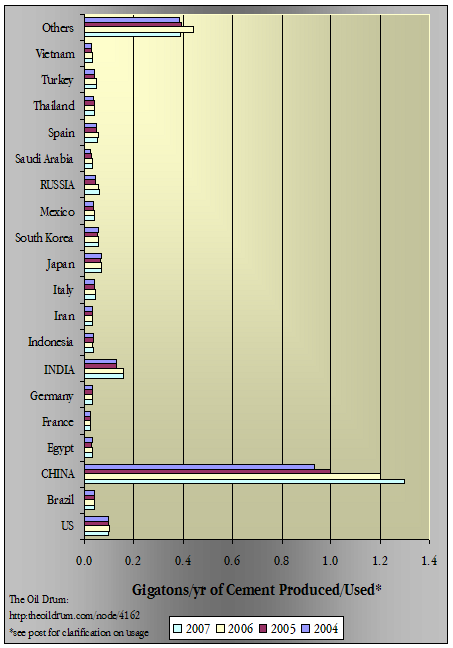 In any case, the graphic above (courtesy of Prof. Goose at The Oil Drum) shows Chinese cement production in 2007 at 1.3*10^9 metric tonnes (1.3 "gigatonnes"). Using the energy input estimate from above, this would involve about 7.8*10^18 joules. This amount of energy in a year is an average power (easily found using WolframAlpha) of 2.47*10^11 watts.
This is a staggering rate of energy use. Typing "7.8*10^18 joules/year in watts" into WolframAlpha yields not only the above number for power but shows that this about 1.9% of the rate of global power consumption. And this is just to make cement, not the power required from limestone quarrying through placing concrete into a structure, let alone all of the other components comprising a completed structure.
Using a variety of approximations and estimates for the amount of "space" this quantity of cement could be used to produce, and the embedded energy in building construction (see here), I estimate that overall energy use in concrete framed construction in China in 2007 was on the order of 3.8*10^19 joules. This is getting to be a very significant portion of world energy usage, on the order of 9%. It's also over 40% of China's total energy usage. This would seem to be the real "Great Leap Forward," but how long can it last?
Wednesday, June 10, 2009
The nature of blogging
I've had the good fortune to be cited at Swans on Tea and to be included in the blog roll at Dot Physics. This has been gratifying, we all want to be heard when we step onto our soapbox. However, it's caused me to wonder what's really going on when we blog.
Naturally, I've gone to other blogs on the blog rolls of each of those sites, and on to others from those. This is what "web surfing" was about back when I first got involved with the internet in 1995 (holy crap, by the way). Several times, through circuitous routes, I wound up coming to various blogs from different directions. Thus, one might speculate that I would find myself in general agreement with the editorial viewpoint of such blogs. After all, I got there, in a sense, from my own. Is this true and does it matter?
The answers are "not necessarily" and "I think so." For example, I wound up on a site called Pharyngula, published by a biologist named PZ Myers. It is a stridently atheistic site. Now, at various times in my life I've been militantly atheistic, I've been a Christian believer, and I've been agnostic. I'm currently in "searching" mode and find much of value in the essays of Professor Steven Dutch's "Science, Pseudoscience, and Irrationalism" pages. Dr. Dutch, a professor in the Earth Sciences department at the University of Wisconsin Green Bay, is relentlessly rational and no one that I've read does a better job of demolishing all manner of pseudoscience. And yet, he is a person of faith.
The Pharyngula blog is one of many at a site called ScienceBlogs. Another is the Denialism Blog which discusses a variety of pseudoscientific and crank ideas. Typical targets are Intelligent Design proponents, global warming denialists, Holocaust denialists, 9/11 conspiracy theorists, etc. Sometimes they may point out the logical fallacies present in the arguments of the denialists, other times they may delve into their psychology. I find myself generally aligned with the viewpoints presented. But not always and not completely.
After a comment I added to a post in Pharyngula I found myself characterized as an idiot, an absolute lunatic, a troll, a slimy troll, and a dipshit (though the person who called me the last weakly retracted it), and was told to "fuck off." Then, not surprisingly, when I did so I was accused of "stomping off in a huff." What was my offense? Well, the post topic was a video featuring Bill Donohue being quite belligerent toward a victim of sexual abuse by the Catholic clergy.
Now, I found Donohue's behavior reprehensible and never said otherwise. But I did feel, reading the comments, an air of smug superiority in the commenters with the flavor of "this kind of thing would never happen but for the unenlightened, superstitious, theistic thinking of the Catholic Church." I concede that I chose a confrontational way of making this point, to wit, I wrote:
"The context of this post and of the video is implying something to the effect that 'theistic thinking increases the likelihood of sexual and physical abuse of minors.'
So, then, may I assume, based on Stalin's Soviet Union, that 'atheistic thinking increases the likelihood of mass murder?'"
My point was that evil is evil and those who engage in it will use whatever is their (or the prevailing) ideology to justify such behavior, should such justification be necessary.
I would not have chosen such an incendiary entry into the discussion but the air of self-righteous chest thumping (interspersed with various suggestions of physical abuse and torture to be inflicted upon Mr. Donohue, quoting one of Myers' favorite phrases, "I kid you not") of some (not all) of the participants was quite off-putting. And yet, I undoubtedly have much in common with many of the contributors. The blogosphere, like politics, makes strange bedfellows.
Naturally, I've gone to other blogs on the blog rolls of each of those sites, and on to others from those. This is what "web surfing" was about back when I first got involved with the internet in 1995 (holy crap, by the way). Several times, through circuitous routes, I wound up coming to various blogs from different directions. Thus, one might speculate that I would find myself in general agreement with the editorial viewpoint of such blogs. After all, I got there, in a sense, from my own. Is this true and does it matter?
The answers are "not necessarily" and "I think so." For example, I wound up on a site called Pharyngula, published by a biologist named PZ Myers. It is a stridently atheistic site. Now, at various times in my life I've been militantly atheistic, I've been a Christian believer, and I've been agnostic. I'm currently in "searching" mode and find much of value in the essays of Professor Steven Dutch's "Science, Pseudoscience, and Irrationalism" pages. Dr. Dutch, a professor in the Earth Sciences department at the University of Wisconsin Green Bay, is relentlessly rational and no one that I've read does a better job of demolishing all manner of pseudoscience. And yet, he is a person of faith.
The Pharyngula blog is one of many at a site called ScienceBlogs. Another is the Denialism Blog which discusses a variety of pseudoscientific and crank ideas. Typical targets are Intelligent Design proponents, global warming denialists, Holocaust denialists, 9/11 conspiracy theorists, etc. Sometimes they may point out the logical fallacies present in the arguments of the denialists, other times they may delve into their psychology. I find myself generally aligned with the viewpoints presented. But not always and not completely.
After a comment I added to a post in Pharyngula I found myself characterized as an idiot, an absolute lunatic, a troll, a slimy troll, and a dipshit (though the person who called me the last weakly retracted it), and was told to "fuck off." Then, not surprisingly, when I did so I was accused of "stomping off in a huff." What was my offense? Well, the post topic was a video featuring Bill Donohue being quite belligerent toward a victim of sexual abuse by the Catholic clergy.
Now, I found Donohue's behavior reprehensible and never said otherwise. But I did feel, reading the comments, an air of smug superiority in the commenters with the flavor of "this kind of thing would never happen but for the unenlightened, superstitious, theistic thinking of the Catholic Church." I concede that I chose a confrontational way of making this point, to wit, I wrote:
"The context of this post and of the video is implying something to the effect that 'theistic thinking increases the likelihood of sexual and physical abuse of minors.'
So, then, may I assume, based on Stalin's Soviet Union, that 'atheistic thinking increases the likelihood of mass murder?'"
My point was that evil is evil and those who engage in it will use whatever is their (or the prevailing) ideology to justify such behavior, should such justification be necessary.
I would not have chosen such an incendiary entry into the discussion but the air of self-righteous chest thumping (interspersed with various suggestions of physical abuse and torture to be inflicted upon Mr. Donohue, quoting one of Myers' favorite phrases, "I kid you not") of some (not all) of the participants was quite off-putting. And yet, I undoubtedly have much in common with many of the contributors. The blogosphere, like politics, makes strange bedfellows.
Saturday, June 06, 2009
The amazing 110 m.p.g. Mustang
Doug Pelmear of HP2g and something called HorsepowerSales.net has made a lot of claims for his engine development. He claims to have developed a "rod and piston" engine capable of developing 400 horsepower and 500 foot pounds of torque. It's also, per Pelmear, capable of 110 m.p.g. equivalent. It's "equivalent" because the engine uses E85 fuel, 85% ethanol and 15% gasoline.
 Pelmear had touted his entry into the Progressive Automotive X Prize competition, whose organizers will distribute a $10M prize pool for teams that produce commercially viable vehicles capable of achieving a sustained fuel economy of 100 MPGe (m.p.g. equivalent). Pelmear's HP2g entry was to have been a 1987 Mustang with his proprietary engine installed. However, a press release dated June 4, 2009 states that the HP2g Mustang has been withdrawn from the competition despite several videos (see here and here for example) showing Pelmear expressing his confidence that he'd win the prize. Various reasons are given for the withdrawal, I have no data regarding the legitimacy of the rationale, so I'll just take it at face value.
 There are several articles on the HP2g web site announcing the opening, on June 1, 2009 of an engine R & D and manufacturing plant. There's also news of an agreement between HP2g and "Revenge Designs" to install the engines in the "Revenge Verde," a super car of some sort. I can't find a lot of detail about the Revenge Verde, but a rendering is at left.
Little information about the actual technology being employed is available on HP2g's web site or in any of the recorded interviews at the various media events Pelmear has attended. He's referred to technology originated during World War 2 by his grandfather and to extensive electronics. There are a couple of vague references to "more precise manufacturing techniques" and "tighter tolerances." In all the videos, the hood of the car is closed and in most the Mustang is sitting still. In the ones where it's moving, it's driving in a very normal fashion, no 400 h.p. tire smoking burnouts. Though his site has a "table of fill ups and miles driven", no independent authentication is given or even implied.
Skepticism is rampant on the Ecomodder Blog about the Mustang, as might be inferred from the title of the article ("runs on hot air and cattle manure" for those not wanting to click on or mouse over the link). I actually commented there and didn't find it to be utterly, completely, totally impossible for Pelmear's claims to be true. But his site includes a section entitled "Test Data" that should enable me to get a more precise estimate as to the plausibility of his claims.
The relevant data is as follows (and compliments to Pelmear and HP2g for publishing them, though the pertinent ones are really just stock Mustang numbers):
 Pelmear had touted his entry into the Progressive Automotive X Prize competition, whose organizers will distribute a $10M prize pool for teams that produce commercially viable vehicles capable of achieving a sustained fuel economy of 100 MPGe (m.p.g. equivalent). Pelmear's HP2g entry was to have been a 1987 Mustang with his proprietary engine installed. However, a press release dated June 4, 2009 states that the HP2g Mustang has been withdrawn from the competition despite several videos (see here and here for example) showing Pelmear expressing his confidence that he'd win the prize. Various reasons are given for the withdrawal, I have no data regarding the legitimacy of the rationale, so I'll just take it at face value.
 There are several articles on the HP2g web site announcing the opening, on June 1, 2009 of an engine R & D and manufacturing plant. There's also news of an agreement between HP2g and "Revenge Designs" to install the engines in the "Revenge Verde," a super car of some sort. I can't find a lot of detail about the Revenge Verde, but a rendering is at left.
Little information about the actual technology being employed is available on HP2g's web site or in any of the recorded interviews at the various media events Pelmear has attended. He's referred to technology originated during World War 2 by his grandfather and to extensive electronics. There are a couple of vague references to "more precise manufacturing techniques" and "tighter tolerances." In all the videos, the hood of the car is closed and in most the Mustang is sitting still. In the ones where it's moving, it's driving in a very normal fashion, no 400 h.p. tire smoking burnouts. Though his site has a "table of fill ups and miles driven", no independent authentication is given or even implied.
Skepticism is rampant on the Ecomodder Blog about the Mustang, as might be inferred from the title of the article ("runs on hot air and cattle manure" for those not wanting to click on or mouse over the link). I actually commented there and didn't find it to be utterly, completely, totally impossible for Pelmear's claims to be true. But his site includes a section entitled "Test Data" that should enable me to get a more precise estimate as to the plausibility of his claims.
The relevant data is as follows (and compliments to Pelmear and HP2g for publishing them, though the pertinent ones are really just stock Mustang numbers):
- Cd (Coefficient of Drag): 0.42
- Frontal Area: 22 ft^2 (2.044 m^2)
- Curb weight: 3250 pounds (curb mass of 1474 kg)
We'll add the following: two 75 kilogram passengers; tires with coefficient of rolling resistance of 0.010 (this is relatively low, but what the heck).
So what does that mean at 55 m.p.h., or 24.59 m/s? Ignoring the energy in the rotating masses and using the methodology I've illustrated many times in the course of this blog, I'd estimate that about 470 newtons would propel this Mustang down the highway at a steady speed on level ground with no wind. As I've frequently mentioned, force times speed is power (assuming that the force is directed parallel to the velocity so that vector calculations aren't required) so 470 newtons at 24.59 m/s requires 11.56 kilowatts or 15.51 horsepower.
Moving on, E85 fuel should have a heat of combustion (that is, energy converted through burning) of 8.653*10^7 j/gal (joules/gallon). I will assume "110 MPGe" means that if E85 had the same specific energy (energy per unit volume) as gasoline, the vehicle would travel 110 miles on a gallon of it. So I'll multiply 110 miles by the ratio of the energy content of E85 to that of gasoline, or 8.653*10^7/1.225*10^8 and speculate that Pelmear is claiming about 77.7 miles out of a gallon of E85. Equivalently, Pelmear would be burning 1/77.7 or 0.01287 gallons of E85 per mile. In that fraction of a gallon, there are 1.1136*10^6 joules of thermal energy available through combustion.
We'll ignore the fuel needed to add the kinetic energy required to get the vehicle to 55 m.p.h. and the various rotating masses in motion and just look at the energy required to maintain 55 m.p.h. with conditions as detailed above. A mile is 1609 meters, so exerting a force of 470 newtons over that distance requires doing work of 756,700 joules. These joules come from burning the E85 so Pelmear is claiming an efficiency of at least (remember we ignored adding kinetic energy, hills, wind, etc.) of 7.567*10^5/1.1136*10^6 or 68%.
This would be above the maximum theoretical thermodynamic efficiency possible with an Otto cycle engine. Even granting that E85 has a significantly higher octane rating than any straight gasoline and thus allows much higher compression ratios to be used and assuming Pelmear has increased his compression ratio to 15:1 (which would require much more massive components than those in a stock gasoline engine), the maximum theoretical efficiency would be about 66%. This assumes no friction in the engine, no throttling or pumping losses, no energy to accessories, etc.
Note that I've given Pelmear the benefit of the doubt at every turn. The most generous assumption I've made is to run the calculations at 55 m.p.h. His site references speeds of 70 m.p.h. where much more energy would be required. And any variance from the idealized conditions hypothesized would reduce the fuel efficiency. I'm sorry, but unless someone points out an error in my calculations or data, I'm calling shenanigans.
Update: I've looked at more of the figures from HP2g's site for fill ups and mileage. They are showing numbers as high as 136.85 m.p.g. (actual miles divided by actual U.S. gallons, MPGe would be much higher). This would mean that the HP2g Mustang was getting significantly more than 100% of the energy available in the E85.
Update 2: A series of email correspondences with HP2g is shown below. Make of them what you will (start at the bottom and work up). Note that the engine "does not necessarily defy the laws of physics" (italics mine).
Update 3: Progressive Insurance Automotive X PRIZE Responds to HP2g Claims
Update 4: In this video the interviewer (from CNN) states that developers think that with a little more tweaking they'll get 500 miles per gallon.
Edison had naysayers too, I'm glad he continued on... Please refrain from contacting us again. First/Last warning.
-----Original Message----- From: Rob
Sent: Monday, June 8, 2009 02:34 PM
To:
Subject: RE: Your claims
Good morning,
No technologies enable more energy to be derived from fuel than is available in the fuel to begin with. Certainly there are thermodynamic cycles other than the Otto cycle, but none of them allow the conversion of more chemical energy to kinetic energy and work than are available in the chemical energy to begin with. Mileage figures such as 136.85 m.p.g. with the drag area of a Mustang and the rolling resistance of any tires currently available would exceed that amount by a considerable margin. There are a variety of reasons why such a claim would be made, but getting more energy out than is in the fuel is not one of them. Pending further information, it's very difficult for me to find such claims plausible. If you can supply such information, fine. If not, I guess time will tell.
Thanks,
Rob
From:
Sent: Monday, June 08, 2009 11:00 AM
To: Rob
Subject: Re: Your claims
Hello, Rob: The HP2g not only has been EPA tested, but its fuel economy has been ested in over 8,000 miles of driving in cities, towns, interstates, desserts, mountains and speed tests. The HP2g’s technologies are not those that you know and are familiar with. The engine does not necessarily defy the laws of physics just our prior understanding of how engines are supposed to work. When we are authorized to release the EPA info we will. It is in our possession. Thank you,
Team HP2g
-----Original Message----- From: Rob
Sent: Monday, June 8, 2009 12:17 AM
To:
Subject: RE: Your claims
Can you provide documentation? It’s very difficult to defy the laws of physics.
Rob
From:
Sent: Sunday, June 07, 2009 9:11 PM
To: Rob
Subject: Re: Your claims
EPA tested.
-----Original Message----- From: Rob
Sent: Sunday, June 7, 2009 10:36 PM
To:
Subject: Your claims
I’m afraid that very straightforward calculations show that your claims, as stated, cannot be correct. I wish that they were.
The calculations are at http://hamiltonianfunction.blogspot.com/2009/06/amazing-110-mpg-mustang_06.html.
If there are errors there, I’m sure you’ll point them out.
Rob
So what does that mean at 55 m.p.h., or 24.59 m/s? Ignoring the energy in the rotating masses and using the methodology I've illustrated many times in the course of this blog, I'd estimate that about 470 newtons would propel this Mustang down the highway at a steady speed on level ground with no wind. As I've frequently mentioned, force times speed is power (assuming that the force is directed parallel to the velocity so that vector calculations aren't required) so 470 newtons at 24.59 m/s requires 11.56 kilowatts or 15.51 horsepower.
Moving on, E85 fuel should have a heat of combustion (that is, energy converted through burning) of 8.653*10^7 j/gal (joules/gallon). I will assume "110 MPGe" means that if E85 had the same specific energy (energy per unit volume) as gasoline, the vehicle would travel 110 miles on a gallon of it. So I'll multiply 110 miles by the ratio of the energy content of E85 to that of gasoline, or 8.653*10^7/1.225*10^8 and speculate that Pelmear is claiming about 77.7 miles out of a gallon of E85. Equivalently, Pelmear would be burning 1/77.7 or 0.01287 gallons of E85 per mile. In that fraction of a gallon, there are 1.1136*10^6 joules of thermal energy available through combustion.
We'll ignore the fuel needed to add the kinetic energy required to get the vehicle to 55 m.p.h. and the various rotating masses in motion and just look at the energy required to maintain 55 m.p.h. with conditions as detailed above. A mile is 1609 meters, so exerting a force of 470 newtons over that distance requires doing work of 756,700 joules. These joules come from burning the E85 so Pelmear is claiming an efficiency of at least (remember we ignored adding kinetic energy, hills, wind, etc.) of 7.567*10^5/1.1136*10^6 or 68%.
This would be above the maximum theoretical thermodynamic efficiency possible with an Otto cycle engine. Even granting that E85 has a significantly higher octane rating than any straight gasoline and thus allows much higher compression ratios to be used and assuming Pelmear has increased his compression ratio to 15:1 (which would require much more massive components than those in a stock gasoline engine), the maximum theoretical efficiency would be about 66%. This assumes no friction in the engine, no throttling or pumping losses, no energy to accessories, etc.
Note that I've given Pelmear the benefit of the doubt at every turn. The most generous assumption I've made is to run the calculations at 55 m.p.h. His site references speeds of 70 m.p.h. where much more energy would be required. And any variance from the idealized conditions hypothesized would reduce the fuel efficiency. I'm sorry, but unless someone points out an error in my calculations or data, I'm calling shenanigans.
Update: I've looked at more of the figures from HP2g's site for fill ups and mileage. They are showing numbers as high as 136.85 m.p.g. (actual miles divided by actual U.S. gallons, MPGe would be much higher). This would mean that the HP2g Mustang was getting significantly more than 100% of the energy available in the E85.
Update 2: A series of email correspondences with HP2g is shown below. Make of them what you will (start at the bottom and work up). Note that the engine "does not necessarily defy the laws of physics" (italics mine).
Update 3: Progressive Insurance Automotive X PRIZE Responds to HP2g Claims
Update 4: In this video the interviewer (from CNN) states that developers think that with a little more tweaking they'll get 500 miles per gallon.
Edison had naysayers too, I'm glad he continued on... Please refrain from contacting us again. First/Last warning.
-----Original Message----- From: Rob
Sent: Monday, June 8, 2009 02:34 PM
To:
Subject: RE: Your claims
Good morning,
No technologies enable more energy to be derived from fuel than is available in the fuel to begin with. Certainly there are thermodynamic cycles other than the Otto cycle, but none of them allow the conversion of more chemical energy to kinetic energy and work than are available in the chemical energy to begin with. Mileage figures such as 136.85 m.p.g. with the drag area of a Mustang and the rolling resistance of any tires currently available would exceed that amount by a considerable margin. There are a variety of reasons why such a claim would be made, but getting more energy out than is in the fuel is not one of them. Pending further information, it's very difficult for me to find such claims plausible. If you can supply such information, fine. If not, I guess time will tell.
Thanks,
Rob
From:
Sent: Monday, June 08, 2009 11:00 AM
To: Rob
Subject: Re: Your claims
Hello, Rob: The HP2g not only has been EPA tested, but its fuel economy has been ested in over 8,000 miles of driving in cities, towns, interstates, desserts, mountains and speed tests. The HP2g’s technologies are not those that you know and are familiar with. The engine does not necessarily defy the laws of physics just our prior understanding of how engines are supposed to work. When we are authorized to release the EPA info we will. It is in our possession. Thank you,
Team HP2g
-----Original Message----- From: Rob
Sent: Monday, June 8, 2009 12:17 AM
To:
Subject: RE: Your claims
Can you provide documentation? It’s very difficult to defy the laws of physics.
Rob
From:
Sent: Sunday, June 07, 2009 9:11 PM
To: Rob
Subject: Re: Your claims
EPA tested.
-----Original Message----- From: Rob
Sent: Sunday, June 7, 2009 10:36 PM
To:
Subject: Your claims
I’m afraid that very straightforward calculations show that your claims, as stated, cannot be correct. I wish that they were.
The calculations are at http://hamiltonianfunction.blogspot.com/2009/06/amazing-110-mpg-mustang_06.html.
If there are errors there, I’m sure you’ll point them out.
Rob
Friday, June 05, 2009
A cornucopia of cluelessness
Not satisfied with the gems I located for A potpourri of cluelessness, my research has revealed more examples of complete misunderstanding of the nature of the physical world. If there's "illiteracy," and "innumeracy" then there should be "ill-physics-acy."
For the first, a hat tip to my friend Michael, the publisher of Only In It For The Gold. He posted this gem. The discussion related to the Zap-X electric car by ZAP, a California Corporation specializing in all types of electric vehicles. I've posted about their Zapino, a small electric scooter.
In any case, the post linked by Michael was to an Ecogeek discussion of the Zap-X, which is apparently a moribund concept. But in the comments, "free energy now" replied to a very rational demolition of the claims for the Zap-X with the following:
"Bruce Your comments in compairing the car to cold fusion means that you're assuming that technology can't change the 746w/hp. Is it at all possible that the cars engines are more efficient then your calculations allow for. There are also ways of using capacitors to increase efficiency in heavy load conditions. Technology is changing my friend, and in a lot of situations the nubers just don't add up. My friend has designed a heater which can run indefinitly after a couple of days of being pluged in. He heats his whole house with them, no they don't use cold fusion, just an ingenious design. So just because you can't figure out the math, doesn't mean it's immposible. Peace out"
Amazing. We're going to change a unit conversion factor using technology. Apparently, such a breakthrough will also enable us to develop overunity devices, overcome the Second Law of Thermodynamics, and achieve perpetual motion. I suggested in my comment on Michael's blog that perhaps we should also be looking into the technological possibility of getting more gallons per liter and more miles per kilometer. In fact, why stop there? I will look into employing technology to change the number of centimeters per inch and make myself taller and lengthen my.... But I digress.
Further, as has been pointed out in the comments to the "In It" post, turning electricity to heat is close to 100% efficient, so it's hardly likely to see dramatic improvements.
Moving on, a "Guest" on the CR4 forum replied to a thread entitled "Overall efficiency of gasoline powered cars" with the following:
"Here is a sample calculation of this... change as you need.. Assume the car travels 1 mile at 30m/sec on a flat road(highway speed... 60mph=88ft/sec about 30m/s) and that it gets 36.7 mpg (conveniently chosen to cancel with your 36.7 kw hour/gal). assume the car is 1000 kg. So energy in for 1 mile is 0.5m*v^2 = 450,000Joules Energy put in for 1 mile in terms of gas is 1gal/36.7miles * 36.7kWhr/gal =1kwhr or 1kJoules/sec*3600Sec = 3.6x10^6 joules... so overall efficiency is 0.45/3.6 = 12.5% for this example... change the parameters to get other results... i.e. mass of car, mpg, average speed etc.. adonaldson@calbaptist.edu engineering prof"
The questioner replied to this answer with "Thanks. That's what I was looking for." It's too bad that he or she found it because it's completely wrong. The "engineering prof" calculated the kinetic energy of the moving vehicle and then somehow decided that that's the energy required to move the vehicle one mile. Of course, the kinetic energy of a given vehicle depends only on its speed and has nothing to do with how far the vehicle travels at that speed. To start from a standstill and accelerate to speed requires turning chemical potential energy into kinetic energy, but so does overcoming aerodynamic drag, rolling resistance, etc., not to mention the kinetic energy of the various rotating masses (flywheel, tires, etc.). All of this was ignored.
If this is truly an engineering prof., I grieve for our future. Of course, even if it isn't I'm not all that sanguine. Anyway, I'm sure I'll find plenty of material for my semi-regular session of poking fun at the published factual ignorance on the 'net.
For the first, a hat tip to my friend Michael, the publisher of Only In It For The Gold. He posted this gem. The discussion related to the Zap-X electric car by ZAP, a California Corporation specializing in all types of electric vehicles. I've posted about their Zapino, a small electric scooter.
In any case, the post linked by Michael was to an Ecogeek discussion of the Zap-X, which is apparently a moribund concept. But in the comments, "free energy now" replied to a very rational demolition of the claims for the Zap-X with the following:
"Bruce Your comments in compairing the car to cold fusion means that you're assuming that technology can't change the 746w/hp. Is it at all possible that the cars engines are more efficient then your calculations allow for. There are also ways of using capacitors to increase efficiency in heavy load conditions. Technology is changing my friend, and in a lot of situations the nubers just don't add up. My friend has designed a heater which can run indefinitly after a couple of days of being pluged in. He heats his whole house with them, no they don't use cold fusion, just an ingenious design. So just because you can't figure out the math, doesn't mean it's immposible. Peace out"
Amazing. We're going to change a unit conversion factor using technology. Apparently, such a breakthrough will also enable us to develop overunity devices, overcome the Second Law of Thermodynamics, and achieve perpetual motion. I suggested in my comment on Michael's blog that perhaps we should also be looking into the technological possibility of getting more gallons per liter and more miles per kilometer. In fact, why stop there? I will look into employing technology to change the number of centimeters per inch and make myself taller and lengthen my.... But I digress.
Further, as has been pointed out in the comments to the "In It" post, turning electricity to heat is close to 100% efficient, so it's hardly likely to see dramatic improvements.
Moving on, a "Guest" on the CR4 forum replied to a thread entitled "Overall efficiency of gasoline powered cars" with the following:
"Here is a sample calculation of this... change as you need.. Assume the car travels 1 mile at 30m/sec on a flat road(highway speed... 60mph=88ft/sec about 30m/s) and that it gets 36.7 mpg (conveniently chosen to cancel with your 36.7 kw hour/gal). assume the car is 1000 kg. So energy in for 1 mile is 0.5m*v^2 = 450,000Joules Energy put in for 1 mile in terms of gas is 1gal/36.7miles * 36.7kWhr/gal =1kwhr or 1kJoules/sec*3600Sec = 3.6x10^6 joules... so overall efficiency is 0.45/3.6 = 12.5% for this example... change the parameters to get other results... i.e. mass of car, mpg, average speed etc.. adonaldson@calbaptist.edu engineering prof"
The questioner replied to this answer with "Thanks. That's what I was looking for." It's too bad that he or she found it because it's completely wrong. The "engineering prof" calculated the kinetic energy of the moving vehicle and then somehow decided that that's the energy required to move the vehicle one mile. Of course, the kinetic energy of a given vehicle depends only on its speed and has nothing to do with how far the vehicle travels at that speed. To start from a standstill and accelerate to speed requires turning chemical potential energy into kinetic energy, but so does overcoming aerodynamic drag, rolling resistance, etc., not to mention the kinetic energy of the various rotating masses (flywheel, tires, etc.). All of this was ignored.
If this is truly an engineering prof., I grieve for our future. Of course, even if it isn't I'm not all that sanguine. Anyway, I'm sure I'll find plenty of material for my semi-regular session of poking fun at the published factual ignorance on the 'net.
Sunday, May 31, 2009
Letting the market do it
I've reiterated my small "l" libertarian leanings (see here for example) on many occasions. Therefore, it would be reasonable to assume that I would be sympathetic to an argument such as the one presented by the Mackinac Center for Public Policy. This is a more focused example of the market oriented philosophy that would also look to market solutions for greenhouse gas emissions, peak oil and its consequences, and pretty much any other issue.
And I am sympathetic to these arguments. But I've come to believe that the market is incapable of providing solutions within the time frames that are relevant to these problems. Many of them, in particular, peak oil (and peak pretty much anything pertaining to natural resources), anthropogenic global warming, and ocean acidification are in this category. The "purchase decision" for solutions to these problems (assuming that solutions even exist) must be made far in advance of any obvious benefit of the purchase. This is one ingredient in a recipe for market failure.
Further, the "market" is dependent on the efficient and accurate transfer of information. Anyone who searches the internet for "anthropogenic global warming" will be bombarded with conflicting information presented as absolute fact. It's almost necessary that he or she become an expert to sort through the noise. And this is not unintentional. The professional noise makers are well aware that destroying the efficiency of the information systems upon which those who make the purchase decision rely is a recipe for maintaining the status quo. This is, of course, their aim.
It's not impossible for purchasers (in this case, the electorate and the population as a whole) to make long-term decisions at short term pain, such is the case for 401K plans, IRA's, insurance purchases, and others. The difference is that (relatively) accurate information about the costs and benefits is available and that someone can make money by providing both the information and the product. Such is not the case when the product is greenhouse gas reduction and reduction in rates of energy utilization, or, to a lesser extent, an increase in vehicle fuel economy. These are, in my opinion, clear examples of market failure.
My friend Michael, over at Only In It for the Gold, is struggling over the failure of the market to provide accurate information. He's a climate scientist and an expert in geophysical modeling. The information gap has become so important to him that he's considering changing his career direction in an attempt to close it. I wish him all success and recommend my readers follow him. There's a link in my blog list at the right side of this page that captures his latest posts.
And I am sympathetic to these arguments. But I've come to believe that the market is incapable of providing solutions within the time frames that are relevant to these problems. Many of them, in particular, peak oil (and peak pretty much anything pertaining to natural resources), anthropogenic global warming, and ocean acidification are in this category. The "purchase decision" for solutions to these problems (assuming that solutions even exist) must be made far in advance of any obvious benefit of the purchase. This is one ingredient in a recipe for market failure.
Further, the "market" is dependent on the efficient and accurate transfer of information. Anyone who searches the internet for "anthropogenic global warming" will be bombarded with conflicting information presented as absolute fact. It's almost necessary that he or she become an expert to sort through the noise. And this is not unintentional. The professional noise makers are well aware that destroying the efficiency of the information systems upon which those who make the purchase decision rely is a recipe for maintaining the status quo. This is, of course, their aim.
It's not impossible for purchasers (in this case, the electorate and the population as a whole) to make long-term decisions at short term pain, such is the case for 401K plans, IRA's, insurance purchases, and others. The difference is that (relatively) accurate information about the costs and benefits is available and that someone can make money by providing both the information and the product. Such is not the case when the product is greenhouse gas reduction and reduction in rates of energy utilization, or, to a lesser extent, an increase in vehicle fuel economy. These are, in my opinion, clear examples of market failure.
My friend Michael, over at Only In It for the Gold, is struggling over the failure of the market to provide accurate information. He's a climate scientist and an expert in geophysical modeling. The information gap has become so important to him that he's considering changing his career direction in an attempt to close it. I wish him all success and recommend my readers follow him. There's a link in my blog list at the right side of this page that captures his latest posts.
Wednesday, May 27, 2009
COMPLETELY off topic
No one who knows me would call me "reliably conservative" or, for the matter of that, "reliably liberal." I do tend toward a viewpoint revolving around upholding the Bill of Rights (strictly, and believing that it means what it says), privacy, personal responsibility, and personal freedom. As I've written previously, I listen to the views of moderates and extremists at both ends (as if political thought were a line segment) of the political spectrum.
During the presidential debates last summer there was the usual blather, easily tuned out as being quite predictable. But in the final debate, Bob Schieffer was questioning the candidates on their views with respect to selection of Supreme Court Justices. Obama stated that "the most important thing in any judge is their capacity to provide fairness and justice to the American People." My ears perked up at this, Obama has taught Constitutional Law. No mention of understanding of the history and meaning of the Constitution of the United States? No mention of common law and equity? I worried.
Now Obama has been presented with the opportunity to put his philosophy into practice. As with all Presidents before him, the rhetoric of his campaign has had to yield to the realities of the office in some cases (appointment of lobbyists to his team, Iraq withdrawal timetable and actualities, etc.) but for the most part he's done what he said he'd do. With respect to the Supreme Court, this is certainly the case. His nomination of Sonia Sotomayor clearly follows the tenets laid out in his debate statements. Of course, it also belies his pro forma statements that his choice will not be based on gender and ethnicity. It's a little far-fetched that the big pushes were to nominate a woman and a Hispanic and that his choice happened to be a Hispanic woman but that race and gender were not motivating factors. I really wish he'd not said something so transparently ridiculous.
More to the point, Justice Sotomayor, from all I've read and heard so far, is an exceptionally intelligent woman and one with an extraordinary record of personal accomplishment. But to what extent will she be able to live up to the oath that she will be required to take should she be confirmed? That oath would be as follows: "I, Sonia Sotomayor, do solemnly swear (or affirm) the I will administer justice without respect to persons, and do equal right to the poor and to the rich, and that I will faithfully and impartially discharge and perform all the duties incumbent upon me as (title) under the Constitution and laws of the United States. So help me God."
The quote being replayed most frequently on the conservative media outlets came from a panel in which Sotomayor participated at Duke University School of Law in 2005. She said "All of the legal defense funds out there, they're looking for people with court of appeals experience, because it is, court of appeals is where policy is made." She went on to say, accompanied by much laughing from the audience, "And... I know this is on tape, and I should never say that, because we don't make law, I know... I'm not promoting it and I'm not advocating it." The Southern California Pacifica outlet, KPFK, played a lengthy excerpt from that panel, implying that the "right wing media" was taking Sotomayor's comments out of context.
I'm no more a follower of right wing talking heads than left, but my impression of the entirety of that series of statements left me with the impression that Sotomayor was acknowledging that she was a policy maker but that, nudge nudge wink wink, "I shouldn't really say so." The audience clearly got the joke.
Sotomayor has also said "I would hope that a wise Latina woman with the richness of her experiences would more often than not reach a better conclusion than a white male who hasn’t lived that life.” Excuse me? What if Justice Scalia had said "I would hope that a wise white male with the richness of his experiences would more often than not reach a better conclusion than a Latina woman who hasn’t lived that life.” His public life would have been immediately over, he would have had to skulk off in disgrace accompanied by the hoots, hollers, and catcalls of the liberal orthodoxy. And, most importantly, RIGHTLY SO. Anyone who holds such views, even if he or she is savvy enough to not declare them outright, should be found out and precluded from judicial service.
Do I think that anyone is capable of machine-like objectivity with complete absence of any influence of his or her life experiences in rendering judicial opinions? Of course not. We're not, after all, Vulcans (I'm referring to old school original series Vulcans, not smarmy, horny, weepy Vulcans of the current Star Trek movie). But the constant goal of a Supreme Court Justice should be to approach, as closely as possible, such detachment. The Constitution of the United States, as amended, has ample protection for the underprivileged. Social policy, within its constraints, is to be determined by the Legislature and executed by the Executive branch as chosen by the electorate. The Judicial branch is tasked with assuring that neither of the other branches violates the protections afforded to the people in the Constitution, as amended.
I'm reasonably sure that, barring some hidden skeleton in Sotomayor's closet, she'll be confirmed. I'm alarmed that the single thing that concerned me most in Obama's pre-election statements is now being carried out in his Presidency. This looks to me like a big step toward government by feeling and not by rule of law. The subtext of much of Obama's domestic policy has revolved around wealth redistribution and social engineering. Given Sotomayor's statements and record, this appears to be a bold step toward pursuing that agenda.
During the presidential debates last summer there was the usual blather, easily tuned out as being quite predictable. But in the final debate, Bob Schieffer was questioning the candidates on their views with respect to selection of Supreme Court Justices. Obama stated that "the most important thing in any judge is their capacity to provide fairness and justice to the American People." My ears perked up at this, Obama has taught Constitutional Law. No mention of understanding of the history and meaning of the Constitution of the United States? No mention of common law and equity? I worried.
Now Obama has been presented with the opportunity to put his philosophy into practice. As with all Presidents before him, the rhetoric of his campaign has had to yield to the realities of the office in some cases (appointment of lobbyists to his team, Iraq withdrawal timetable and actualities, etc.) but for the most part he's done what he said he'd do. With respect to the Supreme Court, this is certainly the case. His nomination of Sonia Sotomayor clearly follows the tenets laid out in his debate statements. Of course, it also belies his pro forma statements that his choice will not be based on gender and ethnicity. It's a little far-fetched that the big pushes were to nominate a woman and a Hispanic and that his choice happened to be a Hispanic woman but that race and gender were not motivating factors. I really wish he'd not said something so transparently ridiculous.
More to the point, Justice Sotomayor, from all I've read and heard so far, is an exceptionally intelligent woman and one with an extraordinary record of personal accomplishment. But to what extent will she be able to live up to the oath that she will be required to take should she be confirmed? That oath would be as follows: "I, Sonia Sotomayor, do solemnly swear (or affirm) the I will administer justice without respect to persons, and do equal right to the poor and to the rich, and that I will faithfully and impartially discharge and perform all the duties incumbent upon me as (title) under the Constitution and laws of the United States. So help me God."
The quote being replayed most frequently on the conservative media outlets came from a panel in which Sotomayor participated at Duke University School of Law in 2005. She said "All of the legal defense funds out there, they're looking for people with court of appeals experience, because it is, court of appeals is where policy is made." She went on to say, accompanied by much laughing from the audience, "And... I know this is on tape, and I should never say that, because we don't make law, I know... I'm not promoting it and I'm not advocating it." The Southern California Pacifica outlet, KPFK, played a lengthy excerpt from that panel, implying that the "right wing media" was taking Sotomayor's comments out of context.
I'm no more a follower of right wing talking heads than left, but my impression of the entirety of that series of statements left me with the impression that Sotomayor was acknowledging that she was a policy maker but that, nudge nudge wink wink, "I shouldn't really say so." The audience clearly got the joke.
Sotomayor has also said "I would hope that a wise Latina woman with the richness of her experiences would more often than not reach a better conclusion than a white male who hasn’t lived that life.” Excuse me? What if Justice Scalia had said "I would hope that a wise white male with the richness of his experiences would more often than not reach a better conclusion than a Latina woman who hasn’t lived that life.” His public life would have been immediately over, he would have had to skulk off in disgrace accompanied by the hoots, hollers, and catcalls of the liberal orthodoxy. And, most importantly, RIGHTLY SO. Anyone who holds such views, even if he or she is savvy enough to not declare them outright, should be found out and precluded from judicial service.
Do I think that anyone is capable of machine-like objectivity with complete absence of any influence of his or her life experiences in rendering judicial opinions? Of course not. We're not, after all, Vulcans (I'm referring to old school original series Vulcans, not smarmy, horny, weepy Vulcans of the current Star Trek movie). But the constant goal of a Supreme Court Justice should be to approach, as closely as possible, such detachment. The Constitution of the United States, as amended, has ample protection for the underprivileged. Social policy, within its constraints, is to be determined by the Legislature and executed by the Executive branch as chosen by the electorate. The Judicial branch is tasked with assuring that neither of the other branches violates the protections afforded to the people in the Constitution, as amended.
I'm reasonably sure that, barring some hidden skeleton in Sotomayor's closet, she'll be confirmed. I'm alarmed that the single thing that concerned me most in Obama's pre-election statements is now being carried out in his Presidency. This looks to me like a big step toward government by feeling and not by rule of law. The subtext of much of Obama's domestic policy has revolved around wealth redistribution and social engineering. Given Sotomayor's statements and record, this appears to be a bold step toward pursuing that agenda.
Wednesday, May 20, 2009
The "smart" car
 I've put "smart" in quotation marks for a reason. Is it smart? Here we have a very small vehicle in which storage space and room for more than two occupants are sacrificed in return for a promise of great economy. Is the trade off worth it?
Let's assume that economy is the only consideration for the purchaser of the smart. The purchaser will then select the smart fortwo Pure, with a base price of $11,990. I'll add A/C, the "Silver metallic tridion safety cell" (though I don't know exactly what it is, since it has the word "safety" in it and everyone I've spoken with is concerned about the smart fortwo's safety, I'll add it), the alarm system and the premium radio. I'll leave out the heated seats, power steering, and metallic paint. The options bring the total to $13,420. We should note that most people don't tend to get the base model, but this will put the best face on the purchase of a Pure.
So what do I get for my $13,420? This is not a car review blog, so I'll only look at the fuel economy aspect of the purchase. The EPA estimates the car to provide 33 m.p.g. in the city, 41 m.p.g. on the highway, and 36 m.p.g. combined. For comparison, the Volkswagen Jetta Diesel gives 30 m.p.g. in the city and 41 m.p.g. on the highway. Admittedly, some won't purchase a diesel. For those, how about the Mini Cooper at 28 m.p.g. city and 37 m.p.g. highway or the Toyota Yaris at 29 m.p.g. city and 36 m.p.g highway? Of course, going the hybrid route will up the mileage ante, but also the price, so we'll ignore those for this post. The low end base price of the Jetta Diesel is $21,990, the Mini Cooper is $18,550, and the Yaris $13,005. The Jetta and the Mini are significantly more costly than the Pure, so we'll go with the Yaris. The base cars in this range are all pretty bare, so we'll figure a similar amount in options and compare the Yaris at about $14,450 and the Pure at $13,420.
The Yaris offers seating for five (nominally) and storage area with a 1.5 liter four cylinder engine. The smart fortwo offers seating (ready now) for two, storage for a few grocery bags, and a 1.0 liter three cylinder engine. Clearly, the Yaris offers significantly more utility at a price that's not dramatically higher. Thus, the big incentive for the purchase of a Pure, other than kitsch, would have to be the fuel economy.
It's recommended that the Pure, whose US engine configuration has a relatively high compression ratio of 10:1, be fueled with premium. Thus, purely from a cost point of view, the Pure is handicapped by about 8% (depending, of course, on actual prices) compared to the Yaris which uses regular grade fuel despite its 10.5:1 compression ratio. Assuming that regular is selling for $2.45/gallon and premium for $2.65/gallon, the Pure will burn $0.0646 worth of premium fuel per highway mile while the Yaris burns $0.0681 worth of regular. In the city, the Pure burns $0.0803 worth as the Yaris burns $0.0845 worth. Because the Pure is fundamentally designed as a city commuter car (though I see them on the freeway) let's analyze a 10,000 mile year (lower than the mean but reasonable for a city car) consisting of 90% city miles. The Pure would burn $723 worth of premium while the Yaris burns $829 worth of regular. The Pure saves $106 in the year, not enough to make a car payment but I would certainly bend over to pick up an envelope with that amount in it.
In terms of carbon dioxide, the Pure would emit something like 5,490 pounds during this "typical" year while the Yaris was emitting about 6,250 pounds, a difference of 760 pounds. The average US family emits something like 22,880 tons of carbon dioxide per year (though I question the accuracy of that figure) so the 0.38 tons saved by the Pure compared to the Yaris seems rather small. In comparison to replacing an incandescent bulb with a compact fluorescent though, it's a big deal.
Is the smart fortwo Pure (or the other higher priced models) worth the sacrifice? For someone who must spend lots of time (and miles) alone or with another person in a car and doesn't anticipate a lot of highway driving, or as a second car in a two car family, it may be a good choice economically. Is its 33 m.p.g. city and 41 m.p.g. highway mileage as good as I'd expect from such a diminutive vehicle? My initial gut reaction was "no" but I'll take a look analytically in another post.
Sunday, May 17, 2009
The Obama High Speed Rail Initiative
President Obama has proposed a $13 billion dollar high speed rail initiative. Based on the statements accompanying his announcement, it would appear that Obama's primary motivation for this program is economic stimulus, although he did state that "we must start developing clean, energy-efficient transportation that will define our regions for centuries to come."
So, how efficient is rail transportation? Surprisingly, not particularly. While the famous CSX claim that railroads can transport a ton of freight 436 miles on a gallon of fuel is factually correct, this outstanding efficiency would not seem to carry over to our passenger rail system. In 2005, Amtrak reported an energy intensity of 2,935 BTU/passenger mile. Using 129,500 BTU/gallon for diesel #2, this is about 44.1 passenger miles/gallon. If I'm on the freeway in my Land Rover LR3 with a passenger in my car, I do as well or better (net of the conversion from the energy equivalent of diesel fuel in automobile gasoline).
On the other hand, very high figures for passenger miles per gallon can be found. For example, on the French TGV Duplex on the Paris-Lyon route with two intermediate stops, the train consumes 17.65 kilowatt hours/train-kilometer over a distance of 427 kilometers, or a total consumption of 7536.55 kilowatt hours. This is 2.7132x10^10 J (joules). This train has 545 passenger seats and if we assume an occupancy factor of 0.8, we see that the train converts 0.0404817 kilowatt hours/passenger kilometer.
Finding an equivalent passenger miles/gallon figure is fraught with difficulty, but let's proceed undaunted. I'll assume a diesel generator with efficiency of 50%, we find that the generator would use 276.26 btu/passenger kilometer or 444.6 btu/passenger mile. This is the fuel in 3.4332*10^(-3) gallons of diesel fuel. This is 291 passenger miles per gallon of diesel fuel. Wow, big difference!
What explains this huge difference? Part of it is the load factor. In fiscal year 2007, Amtrak's load factor was 48.9%, so increasing this to 80% (though this article states that a load factor of 65% technically makes a long distance train sold out, because allowances have to be made for entraining/detraining passengers at intermediate station stops) would effectively increase the passenger miles/gallon to (80/48.9)*44.1 or 72.1 passenger m.p.g. This is still a sad comparison to the TGV Duplex and not much better than airline service. I haven't been able to explain the remaining discrepancy.

The geographical areas contemplated by the Obama plan would seem to make sense for the types of route on which the TGV, for example, excels. That would be routes of intermediate length connecting the center portions of relatively large concentrations of population. There are further advantages of new rail over new road. Most importantly, for a given capacity, the amount of land required for rail is much smaller. This assumes, of course, that that capacity is actually used but the same can be said for passenger cars.
On the other hand, evaluating only from an energy efficiency point of view, it would seem that intercity bus service with a high occupancy factor is easily the best option. And to the extent that people could be induced to leave their cars for buses, the need to build new infrastructure could be avoided. This may be one of the reasons why it doesn't happen.
So, how efficient is rail transportation? Surprisingly, not particularly. While the famous CSX claim that railroads can transport a ton of freight 436 miles on a gallon of fuel is factually correct, this outstanding efficiency would not seem to carry over to our passenger rail system. In 2005, Amtrak reported an energy intensity of 2,935 BTU/passenger mile. Using 129,500 BTU/gallon for diesel #2, this is about 44.1 passenger miles/gallon. If I'm on the freeway in my Land Rover LR3 with a passenger in my car, I do as well or better (net of the conversion from the energy equivalent of diesel fuel in automobile gasoline).
On the other hand, very high figures for passenger miles per gallon can be found. For example, on the French TGV Duplex on the Paris-Lyon route with two intermediate stops, the train consumes 17.65 kilowatt hours/train-kilometer over a distance of 427 kilometers, or a total consumption of 7536.55 kilowatt hours. This is 2.7132x10^10 J (joules). This train has 545 passenger seats and if we assume an occupancy factor of 0.8, we see that the train converts 0.0404817 kilowatt hours/passenger kilometer.
Finding an equivalent passenger miles/gallon figure is fraught with difficulty, but let's proceed undaunted. I'll assume a diesel generator with efficiency of 50%, we find that the generator would use 276.26 btu/passenger kilometer or 444.6 btu/passenger mile. This is the fuel in 3.4332*10^(-3) gallons of diesel fuel. This is 291 passenger miles per gallon of diesel fuel. Wow, big difference!
What explains this huge difference? Part of it is the load factor. In fiscal year 2007, Amtrak's load factor was 48.9%, so increasing this to 80% (though this article states that a load factor of 65% technically makes a long distance train sold out, because allowances have to be made for entraining/detraining passengers at intermediate station stops) would effectively increase the passenger miles/gallon to (80/48.9)*44.1 or 72.1 passenger m.p.g. This is still a sad comparison to the TGV Duplex and not much better than airline service. I haven't been able to explain the remaining discrepancy.

The geographical areas contemplated by the Obama plan would seem to make sense for the types of route on which the TGV, for example, excels. That would be routes of intermediate length connecting the center portions of relatively large concentrations of population. There are further advantages of new rail over new road. Most importantly, for a given capacity, the amount of land required for rail is much smaller. This assumes, of course, that that capacity is actually used but the same can be said for passenger cars.
On the other hand, evaluating only from an energy efficiency point of view, it would seem that intercity bus service with a high occupancy factor is easily the best option. And to the extent that people could be induced to leave their cars for buses, the need to build new infrastructure could be avoided. This may be one of the reasons why it doesn't happen.
Wednesday, May 06, 2009
Clean Tech
 Last Saturday morning I hopped in my Piper Saratoga and flew it from Long Beach, CA to Houston, TX to attend a conference called "Clean Tech." This was, of course, ironic at best and hypocritical at worst, given that the theme of the conference was renewable energy, clean technologies, etc. But it was a nice flight. In any case, I got plenty of material for multiple posts, which is a good thing, since the well had run a bit dry.
Today, the keynote address was given by James Woolsey, former head of the CIA and currently a Senior Vice President at Booz Allen Hamilton and a venture partner at VantagePoint Venture Partners. I found him to be entertaining, well-versed, and engaging. He's a long-time advocate of strong steps to ween ourselves from our security threatening dependence on oil and is quite aware of the issues surrounding peak oil.
I had a chance to speak with Mr. Woolsey for a few minutes after the session. He had advocated taking a series of steps that would result in drastically reducing the role of oil in our society. He drew an analogy with salt in the pre-refrigeration days, when it was the only method of preserving meat. Wars were fought over salt, over trade in salt, etc. He pointed out that technology enabled us to move past the point where salt was anything but a commodity, and outlined his vision for doing the same with oil.
I don't think it will be so easy, but my question related to the effect such a development would have on the political stability in Saudi Arabia, who has already warned us not to be hasty about moving to reduce our dependence on their oil. His position is "better now than later, when they are a nuclear power," certainly a point well taken.
We also spoke briefly about what it takes to get things done in the United States. I suggested that we have developed and refined a nearly flawless system for preventing significant programs from being implemented. Mr. Woolsey pointed out that World War 2 was a counterexample, recalling how the Detroit auto industry turned on a dime to the manufacture of war materials. My regular readers (are you there dear?) will remember that I've pointed out on multiple occasions that the single-minded, goal oriented, "we're all in this together" environment of that time is exactly what is needed and what is missing as we suffocate in our current miasma.
I suggested that the incredible accomplishments of that period couldn't have been made had the political and social environment then been similar to what it is now. He conceded that it will be difficult but stressed that that makes it even more important that we do whatever it takes to achieve consensus around a demand for action.
All in all, I found Mr. Woolsey to be optimistic and determined. It could be argued that he has a dog in the fight financially (several dogs, actually) but I play a lot of poker, and I don't think he's bluffing. It's heartening that people with knowledge, access to capital, and political connections are moving in the right direction.
Credit to Brian at The Goleta Air and Space Museum, an online aeronautical photo and video collection, for the picture of my Saratoga.
Subscribe to:
Posts (Atom)